Why are these connectors blue? Can they be interchanged with the green connectors?
In the fields of fiber optic communication and precision fiber optic sensing, the color of connector housings or sleeves has strict international general specifications (such as the TIA-568 standard). Here are detailed answers to these two questions:
One: Why are these connectors blue?
The color of fiber optic connectors is typically used to quickly identify the fiber type and the polish type of the ferrule end-face:
- Blue Connector: Represents Single-Mode Fiber (SM), with the end-face polished using the PC (Physical Contact) or UPC (Ultra Physical Contact) method.
- End-face Geometry: The ferrule end-face is polished into a tiny spherical shape, but its geometric center line is perpendicular to the fiber axis (i.e., the angle between the end-face center and the fiber axis is 0^{\circ}).
- Green Connector: Represents the end-face polished using the APC (Angled Physical Contact) method.
- End-face Geometry: The ferrule end-face is not only spherical but also polished at an 8^{\circ} angle. This angled design allows reflected light to escape the fiber core, significantly improving return loss (typically \gt 60\text{ dB}), making it ideal for fiber Bragg grating demodulators or high-frequency optical communication systems that are highly sensitive to reflections.
Two: Can they be intermated with green connectors?
Absolutely not, they cannot be directly intermated! Forcing them together will lead to severe mechanical and optical consequences:
- Extremely High Optical Loss and Reflection:
Since the end-face of a blue connector is flat (0^{\circ}) and the end-face of a green connector is angled (8^{\circ}), when they are forced together, close physical contact between the fiber cores of the two fibers cannot be achieved, creating an irrecoverable air gap. This will result in:- Significant insertion loss, leading to severe attenuation or even complete blockage of the optical signal.
- Strong back-reflection, which can cause noise in the laser of precision demodulators and damage the photodetectors at the receiving end.
- Permanent Physical Damage (Scratches):
The end-faces of fiber optic ceramic ferrules are extremely precise. Forcing an APC tip with an 8^{\circ} angle against a flat UPC end-face and locking them together will generate extremely high localized mechanical stress. The ceramic tip of the APC end will press directly onto the fiber core in the center of the UPC end-face, causing permanent scratches, edge chipping, or cracks on the end-face, rendering both connectors unusable.
Correct Connection Rules:
- Blue (UPC) connectors must be connected to blue (UPC) connectors via corresponding UPC adapters.
- Green (APC) connectors must be connected to green (APC) connectors via corresponding APC adapters.
Three: Related Official OFSCN® Products and Interface Support
For high-temperature and harsh working conditions, Dacheng Yongsheng (OFSCN®) offers precision fiber optic patch cords, connectors, and adapter sleeves with different polishing specifications to ensure scientific rigor in physical matching:
-
OFSCN® Standard Fiber Patch Cord:
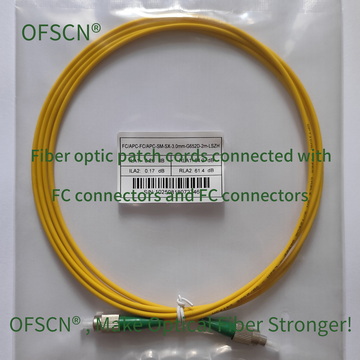
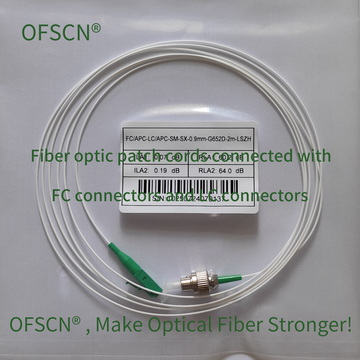
Standard single-mode fiber patch cords. The default connector type is FC/APC (green, 8^{\circ} angled end-face, with excellent return loss), commonly used in Dacheng Yongsheng’s Fiber Bragg Grating (FBG) sensing systems. Customization for FC/PC (blue/metallic), LC/PC, SC/PC, and other specifications is also supported.
-
High-Temperature Fiber Optic Connector Series:
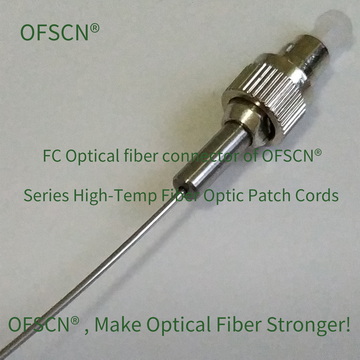
In industrial and experimental scenarios requiring resistance to extreme environments, Dacheng Yongsheng provides high-precision connectors with various temperature ratings. These products are available in FC/PC, FC/APC, ST/PC, ST/APC, SMA905, and other specifications: -
OFSCN® High Temperature Resistant Fiber Optic Adapter:
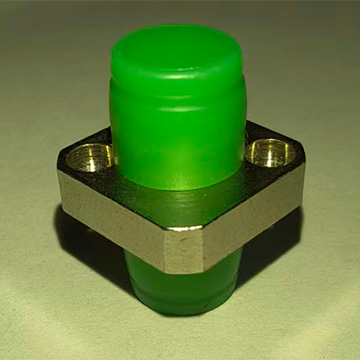
Dacheng Yongsheng’s high-temperature fiber optic adapters support same-type mating such as FC/APC-FC/APC or FC/PC-FC/PC. The internal high-precision ceramic sleeve ensures geometric alignment of the end-faces at both ends, greatly reducing connection loss.