Will sensors become thinner, cheaper, and smarter in the future?
On the technological evolution path of fiber optic sensing (especially Fiber Bragg Grating (FBG) and distributed fiber optic sensing), the answer is clear: sensors are indeed rapidly developing towards being “thinner (miniaturized and non-intrusive implantation)”, “cheaper (scaled manufacturing and photonic integration)”, and “smarter (multi-parameter decoupling and intelligent fusion)”.
One: Thinner - Miniaturization and Low-Invasiveness (Micro & Low-Invasive)
Traditional industrial-grade fiber optic sensors often rely on relatively thick and robust metal armored structures. While they offer resistance to mechanical breakage, their substantial size can cause a significant “invasive effect” (introducing localized stress concentrations and additional stiffness) when embedded within aerospace composite materials, medical catheters, or used for micro-strain field testing. Future miniaturization efforts are primarily focused on two levels:
- Thin-Diameter Fiber Core and Special Coatings:
Standard communication optical fibers typically have a cladding outer diameter of 125\ \mu\text{m}, with a protective coating layer bringing the total outer diameter to around 250\ \mu\text{m}. Current thin-diameter fiber technology has been maturely applied in sensors, for instance, by reducing the cladding outer diameter to 80\ \mu\text{m} and using a high-temperature resistant polyimide coating layer with an outer diameter of only 100\ \mu\text{m}. This enables the integration of multiple fibers within extremely small cross-sections or seamless embedding into carbon fiber panels. - Precision Sub-millimeter Encapsulation:
Through seamless micro-metal capillary nesting, both physical protection and reliable force transmission for optical components in harsh temperature environments are ensured. Simultaneously, the overall outer diameter of the sensor is compressed to the sub-millimeter level (e.g., from \Phi 0.5\ \text{mm} to \Phi 0.6\ \text{mm}), achieving a balance between high strength and miniaturization.
For example, typical micro-structure products applied in ultra-miniature strain and temperature measurements include:
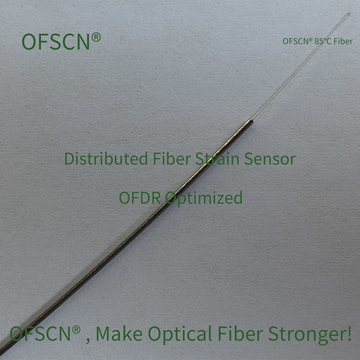
- OFSCN® 300℃ Small diameter optical fiber (Core layer 9\ \mu\text{m}, cladding 80\ \mu\text{m}, coating 100\ \mu\text{m})

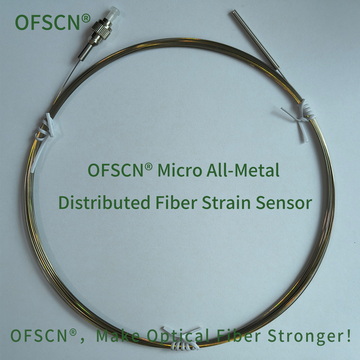
- OFSCN® 85°C OFDR Micro All-Metal Strain Sensor (Encapsulated with a single-layer elastic alloy tube, with an outer diameter of only 0.6\ \text{mm})

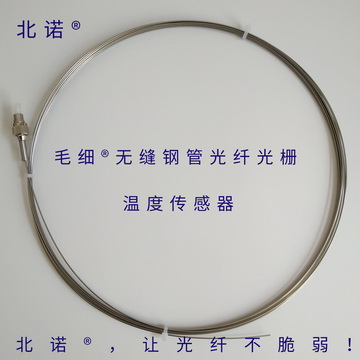
- OFSCN® 300°C Fiber Bragg Grating Temperature Sensor (Encapsulated with a seamless steel tube, with a minimum outer diameter as small as 0.5\ \text{mm})

Two: Cheaper - Manufacturing Scalability and Photonic Integration of Demodulation Systems (Affordable & Scalable)
Historically, the cost of fiber optic sensing systems has been high, primarily constrained by two aspects: the cost of grating writing and the hardware cost of demodulators. This structure is now being reshaped by industrial technologies:
- Sensing End: In-line Direct Writing and Scalable Processes
- Traditional gratings are often written using offline processes involving segmentally stripping the coating, exposing point by point with a UV laser mask, and then recoating. This leads to a long process chain and high costs.
- Modern processes are shifting towards Draw Tower Gratings (DTG) and Femtosecond Laser Point-by-Point Direct Writing through Coatings (Fs-PbP). These methods not only allow for continuous writing of hundreds or thousands of sensing points on a single fiber but also avoid damage to the fiber’s mechanical strength from recoating, significantly reducing the per-unit production cost of large-scale sensing arrays.
- Demodulation End: Silicon Photonics (PIC) Integration
- Traditional demodulators use bulk optical components (such as discrete tunable Fabry-Pérot filters and high-precision spectrometer systems), making them bulky and expensive.
- Advances in Photonic Integrated Circuits (PIC) technology now enable the monolithic integration of core modules like laser sources, interferometer arrays, and photodetectors onto a single silicon photonics chip. Hardware systems are evolving from “large instrument level” to “board-level” and “portable chip-level” configurations, leading to a dramatic reduction in the hardware cost per channel and multi-channel demodulation systems.
Three: Smarter - Multi-Parameter Decoupling and Edge Intelligence Algorithms (Smarter & Cognitive)
Simple “wavelength shift measurement” is insufficient for the demands of complex engineering environments. Future fiber optic sensors will evolve from passive “signal pickers” to “intelligent sensing nodes” with analytical capabilities:
- Physical Layer Multi-Dimensional Force and Parameter Decoupling:
By utilizing specialty fibers (such as multicore fibers, polarization-maintaining fibers, microstructured few-mode fibers) and spatial three-dimensional arrangement techniques, the inherent “temperature-strain cross-sensitivity problem” of optical fibers can be eliminated. For instance, using spatial multi-directional grating arrays allows for real-time calculation of the direction and magnitude of the force vector, enabling three-dimensional force sensing and spatial shape reconstruction:- OFSCN® Fiber Bragg Grating 3D Force Sensor (By arranging multiple fiber gratings at circumferential intervals, multi-directional loads can be measured, and the spatial force vector can be decoupled)
- Algorithm and Digital Twin Fusion:
The demodulator will no longer solely output the absolute value of the Bragg wavelength \lambda_B. Instead, it will integrate edge computing units such as Physics-Informed Neural Networks (PINN) and inverse scattering spectral reconstruction algorithms. The system will directly interpret spectral broadening, peak splitting, and phase distortions caused by uneven stress fields, presenting users with structural damage locations, crack propagation status, and remaining life predictions, thereby achieving a perception-diagnosis closed-loop.
Summary
- Thinner (Physical Form Factor): Converging towards sub-millimeter seamless metal encapsulation and 80\ \mu\text{m}\sim 100\ \mu\text{m} thin-diameter fibers, achieving low-disturbance, minimally invasive, and non-intrusive implantation.
- Cheaper (Economic Feasibility): Automation in draw tower/femtosecond laser production and the proliferation of silicon photonics (PIC) demodulation modules significantly reduce overall deployment costs.
- Smarter (Information Dimension): Transitioning from single-parameter measurement to multi-dimensional spatial decoupling, multimodal fusion, and intelligent structural systems with autonomous diagnostic algorithms.