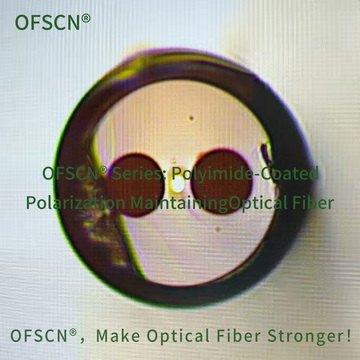
When measuring the quality of polarization-maintaining (PM) fiber, why is this metric important?
1. What is Polarization Extinction Ratio (PER) of Optical Fiber?
Polarization Extinction Ratio (PER) is a core physical parameter that characterizes the polarization-maintaining capability of optical waves in polarization-maintaining devices or transmission media.
When a beam of linearly polarized light is injected along the main axis (typically set as the slow axis or fast axis) of a Polarization-Maintaining Fiber (PMF), the light power ideally remains completely confined to that main axis during transmission. However, due to various microscopic perturbations within and outside the fiber, a portion of the light energy gradually couples to the orthogonal polarization axis.
PER is defined as the ratio of the optical power on the main polarization axis (P_x) to the optical power on the orthogonal axis (P_y) at the output end. It is usually expressed in decibels (\text{dB}) using the common logarithm:
\text{PER} = 10 \log_{10} \left( \frac{P_x}{P_y} \right)
PER is the negative of Polarization Crosstalk (CT, CT = - \text{PER}). The higher the PER measurement (the larger the \text{dB} value), the smaller the orthogonal leakage light and the stronger the polarization-maintaining capability.
2. Why is PER Crucial for Evaluating the Quality of Polarization-Maintaining Fibers?
In optical engineering and sensing applications, PER is the most critical comprehensive metric for evaluating the intrinsic manufacturing quality and actual operating state of polarization-maintaining fibers. The key reasons are reflected in the following four aspects:
(1) Quantifying Mode Decoupling and Polarization Maintaining Capability (A Direct Reflection of Birefringence Quality)
Polarization-maintaining fibers (such as common Panda-type, Bow-tie, or Elliptical Cladding types) achieve extremely high intrinsic modal birefringence (\Delta n = |n_x - n_y| \sim 10^{-4}) by introducing asymmetric stress regions on both sides of the fiber core. This reduces the beat length (L_B) and thereby suppresses phase matching and energy coupling between the two orthogonal modes.
- PER directly reflects the fiber’s ability to suppress energy crosstalk between the two orthogonal intrinsic modes during long-distance transmission.
- The modal coupling coefficient per unit length of the fiber (h parameter) satisfies \text{PER} \approx -10 \log_{10}(h \cdot L). If the fiber has defects in process uniformity such as dopant homogeneity in the stress region, geometric roundness, or axial consistency, uneven internal micro-stress distribution will lead to degradation of the h parameter, causing a significant drop in PER.
(2) Determining the Signal-to-Noise Ratio (SNR) in Interferometric and Coherent Systems
In optical systems based on the principle of interference (such as Fiber Optic Gyroscopes (FOG), coherent optical communications, and polarization-maintaining Mach-Zehnder interferometers), the visibility of interference fringes between two beams directly depends on the purity and consistency of their polarization states.
- If the PER of the PMF is low, leaked light into the orthogonal axis will form parasitic interference signals, leading to reduced fringe contrast, introducing non-reciprocal phase errors, and causing significant measurement drift and bias instability.
(3) Determining the Spectral Purity of Polarization-Sensitive Devices and Grating Sensors
In polarization-sensitive devices (such as Polarization-Maintaining Fiber Bragg Gratings (PM-FBGs)), the birefringence of the fiber causes the Bragg reflection peak to split into two independent peaks for the fast and slow axes.
- High PER ensures that the incident light energy is concentrated on a single polarization peak, avoiding interference between the two peaks and improving the accuracy of wavelength demodulation and the reliability of multi-axis strain/temperature decoupling analysis.
(4) A Sensitive Criterion for Evaluating Resistance to External Mechanical and Thermal Stress Perturbations (Micro-bending and Encapsulation Stress)
During cabling, coating, coiling, or dispensing and curing processes, PMFs inevitably experience lateral squeezing, micro-bending stress, and alternating thermal stresses.
- High-quality PMFs should have a stable stress region structure and well-matched coatings. The PER should remain highly stable when subjected to harsh external forces or high/low-temperature shocks. If the PER significantly degrades with temperature or bending, it indicates poor structural symmetry or insufficient resistance to micro-bending.
3. Related Polarization-Maintaining Product References
In Beijing Dacheng Yongsheng Technology Co., Ltd.'s (OFSCN®) core optical fiber product line, the Panda-type PM optical fiber with a high-precision stress structure design serves as a key base element for achieving extremely low crosstalk and high extinction ratios:
- OFSCN® 300℃ Polyimide Panda-type PM Optical Fiber: This high-temperature resistant Panda-type PM optical fiber features a high-precision Panda stress unit design, with a core diameter of 9\ \mu\text{m}, cladding diameter of 125\ \mu\text{m}, and coating diameter of 155\ \mu\text{m}. It operates at a wavelength of 1550\ \text{nm} and has an operating temperature range of -200\ ^\circ\text{C} to +350\ ^\circ\text{C} (or -270\ ^\circ\text{C} to +350\ ^\circ\text{C}). It is specifically designed for polarization-maintaining transmission and polarization-sensitive sensing in harsh environments with wide temperature variations.