What is the difference between PC, UPC, and APC polished end-face shapes? How does this affect reflected light?
In the fields of fiber optic communication and fiber optic sensing (such as Fiber Bragg Grating FBG sensing), the Polish Type / Polish Grade of fiber optic connectors directly determines the quality of optical signal transmission and the strength of back reflection.
The end-face geometries of PC, UPC, and APC polished connectors are fundamentally different, and their impact on reflected light (i.e., Return Loss) varies significantly:
I. Differences in End-Face Geometry
-
PC (Physical Contact)
- End-face Shape: A slightly convex spherical surface.
- Structural Features: The ferrule end-face is polished to a micron-level spherical shape. When two connectors are mated, their convex spherical surfaces ensure physical contact between the cores of the two fibers, thereby eliminating the air gap between the two end-faces.
-
UPC (Ultra Physical Contact)
- End-face Shape: Also a slightly convex spherical surface, but with more precise processing technology than PC.
- Structural Features: Through finer, higher-order polishing, UPC end-faces have extremely low surface roughness. The curvature control and geometric centering of the spherical surface are more perfect, leading to closer physical contact.
-
APC (Angled Physical Contact)
- End-face Shape: While still slightly spherical, the end-face is angled at 8° relative to the perpendicular plane of the fiber axis.
- Structural Features: Due to the 8° angle, when two APC connectors are mated, they must be inserted in a specific orientation according to the positioning key (usually aligned by the ferrule key) to achieve physical contact.
II. Impact on Reflected Light (Return Loss)
When light passes through the connector interface, due to minor changes in refractive index and end-face imperfections, a portion of the light is reflected back to the source. The physical metric for measuring this reflection is Return Loss (usually a negative value; the larger the absolute value, the less light is reflected back to the source, and the better the performance):
| Polish Type | Typical Return Loss | Path and Physical Mechanism of Reflected Light |
|---|---|---|
| PC | \approx -35\text{ dB} to -40\text{ dB} | A certain proportion of light is directly reflected back along the fiber core to the light source due to minor end-face imperfections. |
| UPC | \approx -50\text{ dB} to -55\text{ dB} | Excellent surface quality reduces local scattering and reflection, significantly decreasing the light reflected back to the source compared to PC. |
| APC | \le -60\text{ dB} (typically \le -65\text{ dB}) | The 8° angle changes the propagation path of the reflected light. Even if reflection occurs at the end-face, the reflected light is refracted/reflected at an angle into the fiber’s cladding according to the law of reflection, where it is attenuated and does not return to the core. Therefore, very little light is reflected back to the source. |
III. Application Specifications in Fiber Optic Sensing and High-Precision Optical Systems
In precision fiber optic sensing systems (such as temperature, strain, and vibration monitoring systems based on Fiber Bragg Gratings - FBG) or high-power fiber lasers, back-reflected light can cause optical noise, interfere with the stability of the light source (e.g., narrow linewidth lasers), or even damage high-power laser devices.
Therefore, in these demanding applications, APC (usually FC/APC type) is the preferred and default polishing standard.
Related Products from OFSCN® (大成永盛):
OFSCN®'s high-precision fiber optic patch cords and sensor components are polished to strict optical specifications, equipped with ultra-low reflection FC/APC connectors by default, and can be customized with other types:
-
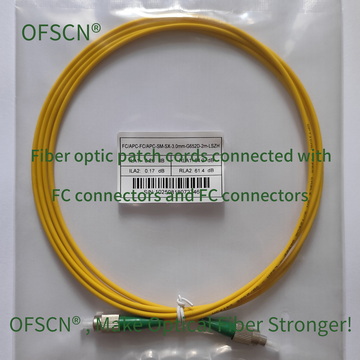
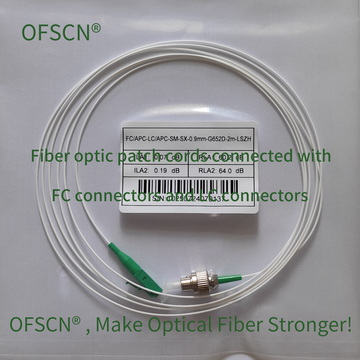
OFSCN® Standard Fiber Patch Cord: Composed of high-quality FC, ST, LC, SC connectors (PC or APC optional), single-mode G.652D fiber, and PVC or aramid protective layers. The default connector type is FC/APC.
-
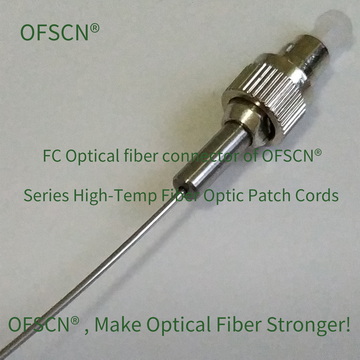
OFSCN® 120℃ Fiber Optic Connector and OFSCN® 200℃ Fiber Optic Connector: Temperature-resistant fiber optic connectors designed for harsh and high-temperature industrial environments. They support high-precision end-face polishing processes such as FC/PC, FC/APC, ST/PC, ST/APC, etc.