Fiber optic sensing why is this wavelength preferred? What is its special status?
Fiber-optic sensing and fiber-optic communication fields recognize 1550 nanometers (nm) as the most crucial golden wavelength, holding an irreplaceable special status. Fiber-optic sensing systems (such as FBG fiber grating sensors, distributed temperature/acoustic sensing DTS/DAS, etc.) widely adopt this wavelength due to a combination of the physical properties of the fiber material, the light-emitting mechanisms of active devices, and the synergistic effects of the optical communication industry chain.
Specifically, its core advantages are evident in the following physical and engineering dimensions:
1. Located in the “Minimum Attenuation Window” of Silica Fiber
Signal transmission loss in Silica Fiber varies with wavelength. Around 1550 nm (i.e., the C-band in optical communication, typically 1530 nm - 1565 nm), silica fiber reaches its inherent minimum absorption and scattering loss limit (approximately 0.2 dB/km), known as the “third window.”
- For Distributed Sensing: Systems like OTDR, DTS, and DAS can transmit optical pulses for tens or even hundreds of kilometers while retaining sufficient detectable weak backscattered signals due to ultra-low loss.
- For Quasi-Distributed Sensing: A larger number of FBG sensors can be cascaded in a long-distance channel without concern for cumulative fiber loss causing signal attenuation.
2. Perfect Compatibility with Erbium-Doped Fiber Amplifiers (EDFA)
In long-distance or high-loss sensing networks, optical signals inevitably require intermediate amplification.
- EDFA (Erbium-Doped Fiber Amplifier) gain spectrum perfectly covers the 1530 nm to 1565 nm wavelength band.
- Weak optical signals at 1550 nm can be efficiently amplified all-optically using EDFA, eliminating the need for complex “optical-electrical-optical” conversion. This significantly reduces the implementation cost and system complexity of ultra-long-haul fiber-optic sensing systems.
3. Highly Mature Industry Chain and Component Support
Due to the telecommunications industry (for backbone optical communication) having established 1550 nm as its absolute core standard over the past decades, optical components in this wavelength range (such as semiconductor lasers, photodetectors, fiber optic couplers, circulators, polarization devices, and high-precision fiber Bragg grating demodulators) have achieved large-scale standardized production.
- This provides the fiber-optic sensing industry with extremely high component reliability, very low technical barriers, and highly competitive hardware costs.
4. Relatively Eye-Safe Wavelength Region (Eye Safety)
Compared to shorter near-infrared wavelengths like 850 nm or 980 nm, 1550 nm light is absorbed by the cornea and lens in the front of the eye and cannot be focused on the retina. Therefore, it falls within the “eye-safe wavelength” category (the threshold power is several orders of magnitude higher than for visible/near-infrared light). This allows for the injection of stronger initial pump light in high-power sensing systems such as coherent laser sensing or LiDAR.
OFSCN® Official Product Support and Technical Assistance
Within the OFSCN® technology and product ecosystem, we have designed and offer a series of specialty optical fibers and Fiber Bragg Grating (FBG) sensors centered around the 1550 nm golden wavelength band, to support physical quantity sensing in harsh environments such as high temperatures and high precision:
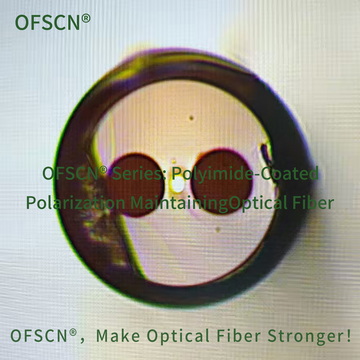
1. OFSCN® 300℃ Polyimide Panda-type PM Optical Fiber (High-Temperature Resistant 300℃ Polyimide Panda-type PM Optical Fiber)
- Technical Features: A high-precision Panda stress structure polarization-maintaining optical fiber optimized specifically for the 1550 nm operating wavelength. It uses a high-temperature resistant 300℃ Polyimide coating, with an operating temperature range of -200℃ to 350℃ (extreme conditions up to -270℃ to 350℃). This ensures high-fidelity transmission of 1550 nm polarized signals in extreme temperatures, widely used in high-precision interferometric sensing, fiber optic gyroscopes, etc.
- Standard Images:

2. OFSCN® Standard Femtosecond Fiber Bragg Gratings / FBG Strings (Bare) (Standard Femtosecond Fiber Bragg Gratings / Grating Strings)
- Technical Features: Their default wavelength range is designed for 1525 to 1565 nm, perfectly matching the 1550 nm core wavelength and its adjacent bandwidth. The femtosecond laser point-by-point writing technology is used, which does not damage the fiber coating, greatly reducing the insertion loss during 1550 nm demodulation.
- Standard Images:


3. OFSCN® Polyimide Fiber Bragg Gratings / FBG Strings (Bare) (Polyimide Recoated Fiber Bragg Gratings / Grating Strings)
- Technical Features: The operating wavelength range is typically 1525 to 1565 nm, with a standard wavelength deviation of ±0.3nm at room temperature. It provides a very high and stable 1550 nm reflection signal peak, suitable for single-point or multi-point sensor string demodulation.
- Standard Images:

For more details on related products, please refer to the OFSCN® Specialty Fiber Products Official Classification Link.