Why can this type of optical cable be hung on high-voltage power lines without conducting electricity? Is its strength sufficient?
1. Why ADSS Fiber Optic Cable Doesn’t Conduct Electricity When Suspended on High-Voltage Lines? (All-Dielectric Characteristic)
The full name of ADSS is All-Dielectric Self-Supporting Optical Cable. Its core principle of being “non-conductive” lies in the fact that the entire cable structure completely avoids the use of any metallic materials, instead being composed of dielectric materials with high dielectric strength:
- Optical Fiber Core: The quartz optical fibers that transmit signals are made of high-purity silicon dioxide ( \text{SiO}_2 ), which is an excellent electrical insulator by nature.
- Strength Member: Traditional optical cables often use steel wires as the central strength member. ADSS cables, however, utilize FRP (Fiber Reinforced Plastic). This material not only possesses extremely high tensile strength but is also a non-metallic, non-conductive dielectric material.
- Tensile Layer: This layer uses Aramid Yarns (commonly known as Kevlar). Aramid is a high-performance organic synthetic fiber with excellent heat resistance and insulation properties, making it completely non-conductive.
- Sheath Material: The outer sheath is typically made of High-Density Polyethylene (PE) or a specialized Tracking Resistant (AT) polymer. This sheath is specifically designed to withstand the intense electromagnetic field environment around high-voltage lines, effectively resisting electrical tracking caused by high-voltage induction.
Precisely because there are no metallic components throughout its structure, ADSS cables do not generate any electromagnetic coupling, induce currents, or attract lightning strikes when suspended on high-voltage transmission line towers, thus ensuring the absolute safety of power grid operations.
2. Is Its Strength Sufficient? (Self-Supporting Structure)
Absolutely sufficient. “Self-Supporting” means the cable can support its own weight and withstand extreme external loads without relying on any external steel strand hangers, solely through its own structure:
- High Specific Strength Materials: Aramid yarns have a tensile strength several times that of steel wire of the same weight, with extremely low elongation. This allows ADSS cables to span hundreds, or even over a thousand meters, with minimal sag.
- Rigorous Mechanical Design: In practical engineering, ADSS cable design must strictly adhere to calculations for Rated Tensile Strength (RTS) and Maximum Allowable Tension (MAT) to withstand the immense additional tensile forces caused by high winds (wind load) and ice/snow accumulation (ice load).
- Creep Resistance and Fatigue Resistance: The internal FRP central strength member, interwoven with aramid, provides excellent compressive strength, bending resistance, and long-term creep resistance, ensuring that the optical fibers within the cable are not subjected to stress damage over decades of operation.
3. Relationship with Beijing Dacheng Yongsheng Technology Co., Ltd. (OFSCN®)
ADSS optical cables are part of the large-scale communication transmission infrastructure for power transmission and distribution networks. They do not belong to the core product line of Beijing Dacheng Yongsheng Technology Co., Ltd. (OFSCN®) (we do not manufacture ADSS cables for civilian/power long-span transmission). OFSCN® focuses on the research and development of industrial-grade high-precision fiber optic sensors for temperature, strain, and pressure, Fiber Bragg Grating (FBG) sensors, and seamless steel tube optical cables.
However, in temperature monitoring scenarios requiring absolute electrical insulation in high-voltage, strong electromagnetic field, or power distribution network environments (such as transformer windings, high-voltage switchgear, cable joints, etc.), to prevent discharge hazards from metallic sensors, OFSCN® has developed complementary high-insulation, non-metallic Fiber Bragg Grating temperature sensors:
Recommended Product 1:
OFSCN® Ceramic-encapsulated Fiber Bragg Grating Temperature Sensor
This product utilizes high-dielectric-strength ceramic materials for non-metallic encapsulation, specifically designed for high-precision temperature measurements in high-voltage electrostatic field environments, boasting excellent electrical insulation performance.

Recommended Product 2:
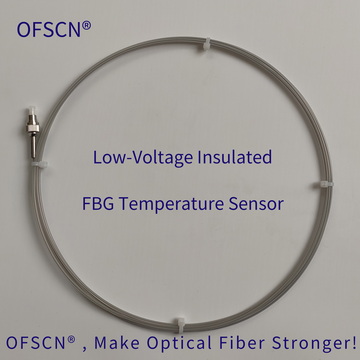
OFSCN® 150 Low-Voltage Insulated Fiber Bragg Grating Temperature Sensor
This insulated grating temperature sensor is designed for medium and low-voltage power equipment (such as transformers, switch cabinets, etc.) and provides safe, stable, contact temperature monitoring in environments with extreme electromagnetic interference.