How can machine learning help to identify complex vibration patterns (such as crawling and excavation)?
In distributed fiber acoustic/vibration sensing (e.g., DAS/DVS systems, primarily based on phase-sensitive Optical Time-Domain Reflectometry \Phi\text{-OTDR}) or Distributed Fiber Optical Frequency Domain Reflectometry (OFDR) technologies, Machine Learning (ML) and Deep Learning (DL) primarily achieve high-accuracy identification and low false-alarm rates for complex vibration events (such as fence/wall climbing, manual/mechanical excavation, vehicle passage, etc.) through steps like physical signal denoising, multi-dimensional feature extraction, pattern classification, and spatio-temporal correlation.
1. Physical Signal Acquisition and Preprocessing
External physical disturbances (e.g., wall chipping, seismic waves from mechanical excavation) acting on sensing optical fibers laid on walls or buried underground cause minute strain and stress variations in the fiber.
- Signal Conversion: Detectors capture phase or intensity changes in the fiber’s backscattered Rayleigh light, obtaining time-domain vibration signals with high sampling rates.
- Denoising Preprocessing: The raw signal is often contaminated with ambient background noise (e.g., wind and rain, distant traffic noise). ML systems first enhance the signal-to-noise ratio (\text{SNR}) using algorithms like Wavelet Denoising, Empirical Mode Decomposition (EMD), or Autoencoders.
2. Feature Engineering and Time-Frequency Transformation
Different vibration sources exhibit distinct physical characteristics in terms of time, frequency, and energy distribution:
- Time-Domain and Frequency-Domain Feature Extraction:
- Wall Climbing/Ascent: Primarily manifests as intermittent, localized, sudden low-frequency impulse signals with energy concentrated in specific frequency bands.
- Mechanical Excavation/Wall Chipping: Appears as continuous, high-frequency, strong energy vibrations with periodic pulse repetition characteristics.
- Environmental Interference (e.g., wind/rain): Exhibits as distributed, irregular, broadband low-energy noise over a large spatial area.
- Time-Frequency Spectrogram Mapping: Through Short-Time Fourier Transform (STFT) or Continuous Wavelet Transform (CWT), one-dimensional time-series vibration signals are mapped into two-dimensional “time-frequency images” (Spectrograms). Spectrograms can simultaneously display the evolution of vibration energy over time and frequency.
3. Pattern Recognition and Classification Models
Based on the extracted features or two-dimensional time-frequency images, ML and DL models perform pattern recognition:
- Traditional Machine Learning Algorithms: Employ algorithms like Support Vector Machines (SVM), Random Forests, or k-Nearest Neighbors (KNN), using engineered feature vectors such as time-domain steepness, zero-crossing rate, and frequency-domain energy distribution to achieve rapid binary or multi-class classification of events.
- Deep Learning Convolutional and Temporal Networks:
- Convolutional Neural Networks (CNN / ResNet): Utilize two-dimensional spectrograms as input, employing convolutional kernels to automatically extract deep textural and time-frequency distribution features, enabling precise discrimination of disturbance types with extremely similar waveforms.
- Recurrent Neural Networks and Transformers (LSTM / GRU / Spatial-Temporal Transformer): Introduce temporal dependencies, capturing the evolutionary patterns of vibration over time (e.g., the continuous action sequence of “person touches-climbs-crosses”), thereby significantly reducing false alarms caused by isolated, single impacts.
4. Spatial-Temporal Analysis
Distributed fiber sensing provides a two-dimensional perception matrix along the fiber axis distance z and time t:
- Trajectory Tracking and Spatial Localization: ML algorithms combine fiber location coordinates to analyze the diffusion patterns of vibration signals propagating along the fiber. For instance, when a person walks or climbs along a wall, the vibration epicenter exhibits continuous displacement in the spatial dimension z over time t; heavy rainfall, on the other hand, appears as sporadic noise synchronized across the entire line.
5. Sensing Medium and Signal Quality Assurance
The accuracy of AI recognition algorithms is highly dependent on the quality and fidelity of the signals transmitted from the fiber sensing end. If the sensing fiber is affected by external environmental factors leading to signal attenuation or strain transmission distortion, it directly impacts the feature extraction of the classification models.
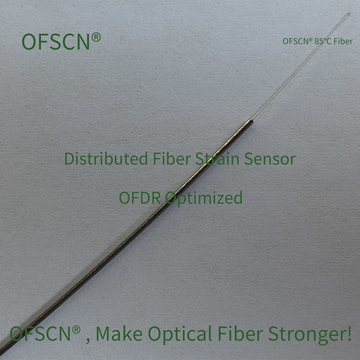
Beijing Dacheng Yongsheng Technology Co., Ltd. (OFSCN®) provides metal-encased distributed sensing optical cables (such as OFSCN® 85°C Seamless Steel Tube Fiber Cable) and micro all-metal strain sensors (such as OFSCN® 85°C OFDR Micro All-Metal Strain Sensor). Utilizing seamless steel tube or elastic alloy tube structures, these products efficiently and faithfully transmit external vibrations and minute stresses to the fiber core, providing a high signal-to-noise ratio physical data foundation for DAS/DVS and OFDR devices and backend AI algorithms.