Why is the connector end face ground at an 8-degree bevel? Why is it green?
In the fields of optical fiber communication and optical fiber sensing, APC (Angled Physical Contact) is a crucial fiber end-face grinding process. Regarding your two questions, here are the answers from the perspectives of optical physics principles and international industry standards:
I. Why is the connector end-face ground at an 8^\circ angle?
This is primarily to minimize Return Loss (RL) and prevent reflected light from interfering with laser light sources or Fiber Bragg Grating (FBG) demodulation equipment.
-
Altering the path of reflected light:
During optical transmission, when light reaches the end of an optical fiber (the interface between silica glass and air), Fresnel Reflection occurs due to the sudden change in refractive index.- For flat PC or UPC connectors, the reflected light travels directly back into the core along the original path, returning to the light source or demodulator. This can cause phase noise and instability in lasers, reducing the signal-to-noise ratio of sensing systems.
- For APC connectors, the end-face is ground at an 8^\circ angle. When light is reflected at the angled end-face, the reflected ray is angled relative to the fiber axis. This angle typically exceeds the critical angle for total internal reflection within the fiber core, so the reflected light cannot propagate further within the core but instead leaks into the fiber cladding to dissipate.
-
Why specifically 8^\circ?
8^\circ is the optimal balanced angle determined through precise theoretical calculations and experimental verification:- If the grinding angle is too small (e.g., less than 5^\circ), some reflected light may still satisfy the condition for total internal reflection and propagate backward in the core, reducing the effectiveness of echo loss suppression.
- If the grinding angle is too large (e.g., greater than 10^\circ), although return loss performance is better, it significantly increases the difficulty of mechanical alignment during connector mating, raises insertion loss (IL), and adds complexity to the manufacturing process.
- For standard single-mode fibers (like G.652.D, with a numerical aperture \text{NA} \approx 0.14), an 8^\circ angle is sufficient for almost all reflected light to escape the core.
Note: With APC grinding, the connector’s return loss can be reduced to below -60\text{ dB} (meaning the reflected light intensity is less than one in a million of the incident light), whereas planar-ground UPC is typically -50\text{ dB}, and PC is typically -40\text{ dB}.
II. Why is it green?
This is an international industry standard color code (e.g., TIA-568 standard) established to prevent equipment damage or signal failure due to accidental physical misconnection.
-
Color coding prevents human error:
- Blue (Blue): Represents single-mode PC/UPC (Physical Contact/Ultra Physical Contact) connectors.
- Green (Green): Represents single-mode APC (Angled Physical Contact) connectors.
-
Severe consequences of misconnection:
- If a blue UPC connector is accidentally plugged into a green APC adapter (or vice versa), because one end-face is flat and the other is angled, they will only achieve partial point contact when physically mated, creating a large angled air gap in between.
- This results in extremely high insertion loss (typically greater than 3\text{ dB}) and poor return loss, rendering the optical path almost unusable.
- More seriously, due to uneven force, the asymmetric collision can permanently scratch or physically damage expensive demodulator interfaces and sensor connectors.
- Using a uniform green housing (and green adapter flange) allows technicians to identify them at a glance from a distance and in complex field environments, thus preventing catastrophic misconnections.
Related Official OFSCN® Products
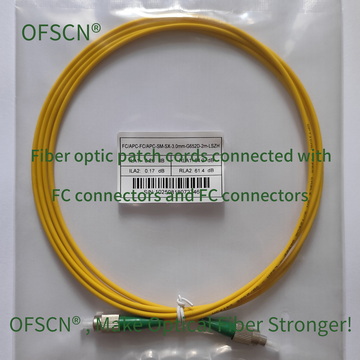
OFSCN® (大成永盛) manufactures various fiber optic patch cords, connectors, and Fiber Bragg Grating (FBG) sensors. In single-mode configurations, these products default to FC/APC (green) connectors to ensure high precision and low noise in optical measurements. Various high-temperature customized models are also available.
-
OFSCN® Standard Fiber Patch Cord: Standard single-mode fiber patch cords, defaulting to high return loss FC/APC connectors for excellent optical compatibility.
-
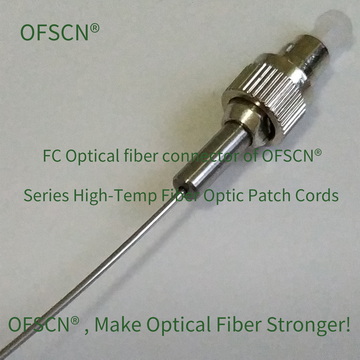
OFSCN® 120℃ Fiber Optic Connector: High-temperature 120℃ fiber optic connectors, including various models such as FC/APC and SC/APC.
-
OFSCN® 300℃ Fiber Optic Connector: Professional industrial fiber optic connectors with high-temperature resistance up to 300℃, supporting the FC/APC standard.