Wird die langfristige starke Vibration bei der Verwendung in Hochgeschwindigkeitszügen oder auf großen Brücken die Glasfaser lockern?
In engineering environments such as high-speed railways and large bridges, which experience prolonged severe vibrations, dynamic alternating loads, and impacts, the stability and durability of fiber optic systems are paramount in optical engineering design.
I. Principles of Vibration Impact on the Physical Properties of Optical Fibers and Fiber Optic Systems
Silica (quartz) optical fibers possess inherently high tensile strength. However, without special protective encapsulation, prolonged and intense vibrations primarily pose the following three engineering risks to optical fibers and their systems:
- Relative Displacement (Loosening) between Optical Fiber and Protective Sheath
If traditional loose tubes or non-tightly filled plastic sheathed fiber optic cables are used, high-frequency or continuous impact vibrations can cause axial sliding, creep, or microbend accumulation of the optical fiber within the tube. This not only alters the local strain state of the fiber but also impairs the strain transmission efficiency during sensing measurements. - Microbending Loss and Optical Signal Fluctuations
Under dynamic vibration, the bending radius of the optical fiber undergoes small, high-frequency changes, known as microbending. Microbending causes some light modes transmitted in the fiber core to leak into the cladding, leading to dynamic fluctuations in optical signal attenuation or increased loss. - Connector Loosening and Stress Corrosion Fatigue
Vibrations can easily cause micro-displacements or physical loosening of fiber optic connectors (such as ferrule connectors, threaded connections), affecting the accuracy of interface mating. Furthermore, at fixed clamping points or diameter transitions, prolonged alternating stresses (e.g., vibration frequencies maintained within the range of f > 10\text{ Hz} to 100\text{ Hz}) can lead to the expansion of micro-cracks on the silica surface (stress corrosion fatigue), triggering fiber material fracture.
II. Engineering Protection Mechanisms for High-Vibration Environments
To prevent prolonged severe vibrations from causing optical fiber loosening or damage, engineering commonly employs metal armored encapsulation (FIMT - Fiber in Metal Tube) and polymer curing integration techniques:
- Mechanical Isolation:
Utilizing elastic alloy tubes or seamless stainless steel tubes as protective barriers to isolate external mechanical impacts and shear forces. - Mechanical Locking:
Through interference fit solidification within the metal tube or tight-fitting processes, the optical fiber is fixed as one unit with the protective structure, completely eliminating relative displacement and loosening between the optical fiber and the sheath.
III. Official Related Products and Technical References
OFSCN® has developed armored fiber optic sensing and transmission products with strong anti-vibration characteristics for high-vibration and harsh engineering environments:
1. OFSCN® Alloy Tube Packaged Fiber Bragg Grating strain sensor
This product uses an elastic alloy tube to encapsulate Fiber Bragg Gratings, specifically designed for strain monitoring in high-vibration environments such as bridges and high-speed railway tracks. The metal tube structure not only withstands high-frequency impacts but also ensures the fiber is fixed immovably within the tube, achieving high-fidelity strain transmission.



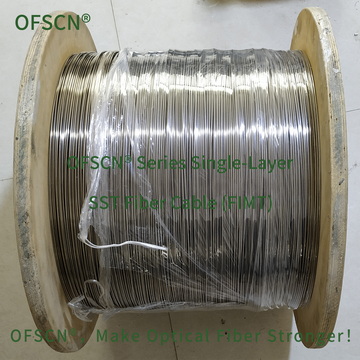
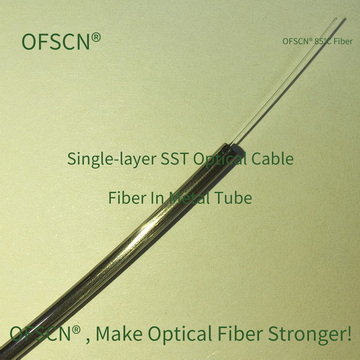
2. OFSCN® 85°C Seamless Steel Tube Fiber Cable
Utilizes a single-layer stainless steel seamless steel tube (default outer diameter 2.0\text{mm} or 3.0\text{mm}) for protection, serving as a high-strength distributed sensing or signal transmission fiber optic cable. The seamless steel tube structure provides extremely high rigidity and resistance to vibration and loosening, effectively preventing optical fiber loosening and mechanical damage in harsh vibration environments.