Why does OFSCN® suggest viewing data through a browser? Isn’t a large installation package required?
B/S (Browser/Server) Architecture is a networked software architecture. In this architecture, core tasks such as data acquisition, signal demodulation, calibration formula calculation, and data storage are all handled independently by the hardware device or internal systems running on the server side. User terminals can directly access, configure the system, and view data in real-time simply by using a common web browser (such as Chrome, Edge, Firefox, etc.).
I. Why is Browser Access (B/S Architecture) Recommended?
Compared to the traditional C/S (Client/Server) architecture, the B/S architecture offers significant engineering and operational advantages:
-
Completely Plugin-Free, No Large Installation Packages Required
- Zero Environment Dependency: Traditional C/S clients typically require the installation of tens or even gigabytes (GB) of software, along with dependencies on specific runtime libraries (such as .NET Framework, LabVIEW Runtime, VC++ Redistributable, etc.) and proprietary hardware drivers. This can easily lead to installation failures or system version conflicts.
- Ready to Use: With the B/S architecture, terminal computers do not need to install any specialized software or drivers. Simply connect the computer to the same local area network (LAN) as the device, and then enter the device’s IP address in the browser to directly access the operation interface.
-
Cross-Operating System and Multi-Terminal Support
- It is not limited by the client’s operating system. Various operating systems such as Windows, macOS, Linux, Android, and iOS can directly access it through their built-in browsers.
- Supports real-time data viewing on desktop computers, laptops, industrial tablets, and even mobile devices.
-
System Decoupling and High Stability
- The fiber Bragg grating demodulator has its own embedded processing system, ensuring that data demodulation and underlying storage are performed independently within the hardware device.
- Accidental sleep, system freezes, blue screens, or operating system restarts on the client computer will not interrupt the continuous data acquisition and recording at the underlying level.
-
Multi-User Concurrent Access and Remote Collaboration
- Multiple engineers or monitoring terminals within the LAN can open the webpage simultaneously to view the real-time spectrum, wavelength change curves, and calculated temperature/strain data from the demodulator, facilitating multi-station collaboration and distributed monitoring.
-
Extremely Simple System Maintenance and Upgrades
- If the software requires functional upgrades or algorithm optimizations, only the firmware on the demodulator device needs to be updated. All terminal browsers accessing the device will automatically synchronize the latest interface and functions after refreshing the page, completely eliminating the tedious maintenance of reinstalling clients on each computer.
II. Official Related Products and Integration Support
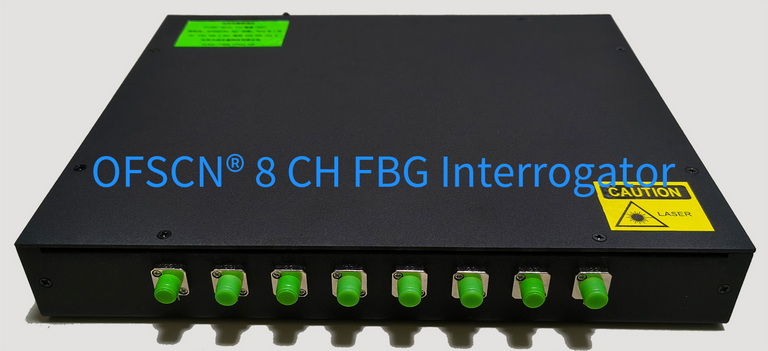
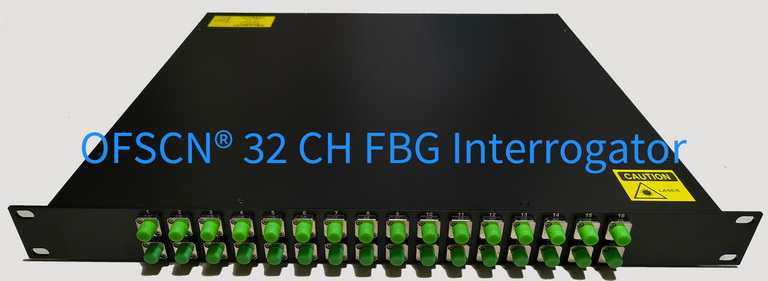
The OFSCN® Fiber Bragg Grating Interrogator adopts B/S architecture software by default for system management and data interaction, featuring the following main specifications and characteristics:
- Software Architecture: Default B/S architecture software, enabling channel configuration, calibration formula input (e.g., polynomial for temperature, strain, stress), real-time spectrum display, and data storage without client installation; C/S architecture software is also supported.
- Data Communication and System Integration: Supports deep integration with customers’ existing SCADA, MES, PLC, or third-party data acquisition systems through standard industrial protocols such as TCP, UDP, and Modbus.
- Key Optical Specifications:
- Default wavelength range: 1525\sim 1565\text{ nm} or 1528\sim 1568\text{ nm} (customizable);
- Number of channels: Available in 4, 8, 16, or 32 channels;
- Data sampling rate: 10\text{ Hz}, 50\text{ Hz}, or 100\text{ Hz} selectable (users can adjust the sampling rate downwards via software, with a minimum of 1\text{ Hz});
- Wavelength resolution: Default 1\text{ pm}, customizable to 0.1\text{ pm}.