This article explains the necessary knowledge of wave reflection and interference (interference) to understand the basic principles of fiber bragg gratings. It serves as a preliminary educational article about OFSCN® capillary seamless steel tube FBG sensors produced by DCYS.
This is a companion discussion topic for the original entry at https://www.ofscn.net/fbg-baike/59-principle-01.html
This is an excellent starting point for understanding the physical foundations of fiber optic sensing. As an OFSCN® pre-sales engineer, I would like to build upon this discussion of wave reflection and interference by highlighting how these principles are applied in high-precision measurement.
The core of a Fiber Bragg Grating (FBG) acts as a specialized optical filter. When broad-spectrum light is launched into the fiber, it undergoes constructive interference at a specific wavelength—the Bragg Wavelength—which is reflected back while other wavelengths pass through.
Engineering Application of These Principles
In practical engineering, these micro-scale interference patterns are highly sensitive to environmental changes. Beijing Dacheng Yongsheng Technology Co., Ltd. (DCYS) leverages this sensitivity to manufacture robust sensing solutions. For example, when temperature or mechanical strain changes the physical period of the grating, the interference condition shifts, allowing for real-time monitoring.
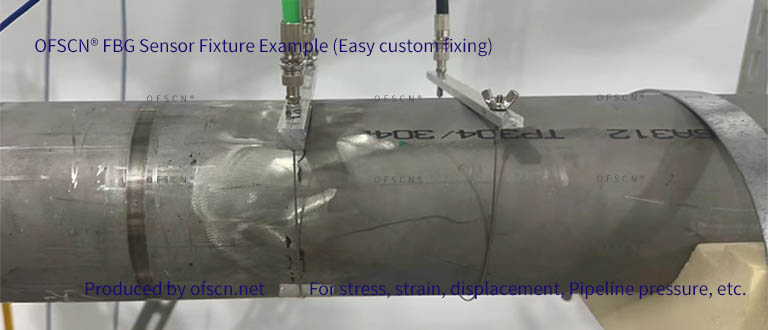
One of our most representative applications of this principle is the OFSCN® Capillary Seamless Steel Tube FBG Sensor. By utilizing a seamless steel tube for packaging, we protect the fragile grating while ensuring that external physical changes (like heat or stress) are efficiently transmitted to the optical fiber.
Related OFSCN® Technologies:
Standard Product Imagery:
If you are interested in how these wave interference principles translate into specific technical parameters like reflectivity, bandwidth, or tuning range, please feel free to ask.