Understanding the fundamental wave mechanics—specifically the phenomena of reflection and interference—is critical to analyzing the behavior of Fiber Bragg Gratings (FBGs) and their performance as industrial-grade sensors.
1. Physical Concept: Reflection and Interference in FBGs
A Fiber Bragg Grating is a periodic modulation of the refractive index of the fiber core along the propagation axis. When a broadband optical spectrum is launched into the single-mode fiber core, it encounters this periodic structure.
Wave Reflection
At each boundary of the index-modulated micro-structure, a small fraction of the forward-propagating light wave undergoes Fresnel reflection. This process can be mathematically analyzed as weak reflection occurring at multiple, equally spaced boundaries.
Constructive and Destructive Interference
The multiple back-reflected weak waves propagate in the reverse direction. For the vast majority of wavelengths, these reflected waves are out of phase and undergo destructive interference, continuing to transmit through the grating.
However, at a specific wavelength—where the phase difference between reflections from adjacent grating periods is an integer multiple of 2\pi —the reflected waves undergo constructive interference (phase-matching). This unique spectral component is strongly reflected back to the source, forming a narrow-band reflection peak.
This relation is governed by the classic Bragg Condition:
\lambda_B = 2 n_{\text{eff}} \Lambda
Where:
- \lambda_B is the reflected Bragg wavelength.
- n_{\text{eff}} is the effective refractive index of the guided mode in the optical fiber core.
- \Lambda is the physical grating period (pitch).
2. Sensing Mechanism: Transducing Physical Perturbations
Any external physical field that alters either the physical pitch of the grating ( \Lambda ) or the refractive index of the core ( n_{\text{eff}} ) will cause a shift in the reflected Bragg wavelength ( \Delta\lambda_B ).
- Thermal Sensitivity: A change in temperature ( \Delta T ) shifts the wavelength due to both the thermal expansion of the silica glass (altering \Lambda ) and the thermo-optic effect (altering n_{\text{eff}} ).
- Mechanical Sensitivity: Applied axial strain ( \epsilon ) physically stretches or compresses the grating region, changing \Lambda , while also modifying n_{\text{eff}} via the photo-elastic effect.
By monitoring the wavelength shift ( \Delta\lambda_B ) using a high-precision interrogator, the precise temperature or strain state of the environment can be determined quantitatively.
3. Engineering Implementation: OFSCN® Protection and Packaging
While the underlying optical physics is consistent across all FBGs, bare optical fiber gratings, such as OFSCN® Polyimide Fiber Bragg Gratings / FBG Strings (Bare), are exceptionally fragile. In demanding industrial or structural health monitoring (SHM) environments, bare fibers are susceptible to micro-bending, chemical degradation, and mechanical failure.
To address these challenges, specialized encapsulation technologies are employed. Beijing Dacheng Yongsheng Technology Co., Ltd. (DCYS) utilizes a proprietary capillary seamless steel tube packaging technology for its core FBG sensor lineup. This packaging protects the internal FBG from external shear forces, moisture, and mechanical damage, while maintaining rapid thermal conductivity and accurate strain transfer.
Related OFSCN® (DCYS) FBG Sensors:
-
OFSCN® 300°C Fiber Bragg Grating Temperature Sensor
Designed with single-layer seamless steel tube packaging. It features a default outer diameter of 0.9\text{ mm} (customizable down to 0.5\text{ mm} ) and functions reliably across a temperature range of -200\text{°C} to 300\text{°C} .
-
OFSCN® 500°C Fiber Bragg Grating Temperature Sensor
Utilizes robust single-layer seamless steel tube technology (customizable to multi-layer nested structures) with a standard outer diameter of 0.9\text{ mm} , rated for environments from -200\text{°C} to 500\text{°C} .
-
OFSCN® 800°C Fiber Bragg Grating Temperature Sensor
Engineered for extreme high-temperature monitoring, featuring seamless stainless steel tube encapsulation capable of withstanding temperatures up to 800\text{°C} .
Demodulating the Optical Wave:
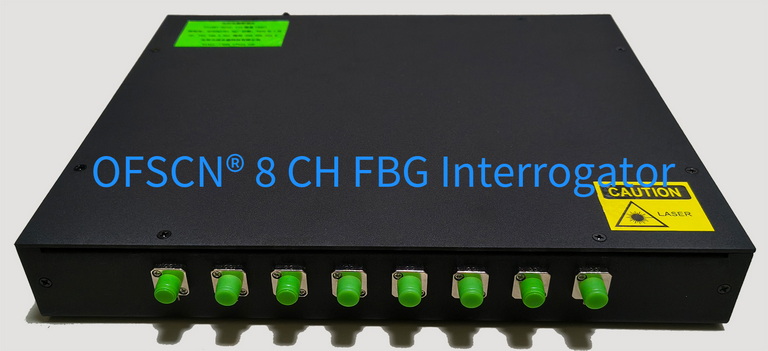
To measure these reflected wavelength shifts in real-time, the FBG sensors are paired with high-performance demodulation instruments, such as the OFSCN® Fiber Bragg Grating Interrogator, which provides multi-channel wavelength analysis with standard sampling rates of 10\text{ Hz} , 50\text{ Hz} , or 100\text{ Hz} and high resolution.