Uydu veya uzay istasyonunda fiber optik, kozmik ışınlara ve aşırı vakum ortamına dayanabilir mi?
Fiber optics can not only enter space, but have also become a key fundamental component in modern satellites, space stations, and deep space probes, widely used in onboard high-speed data bus communication, fiber optic gyroscope (FOG) attitude control, and spacecraft structural health monitoring and thermal control systems based on fiber Bragg gratings (FBG).
However, conventional terrestrial civil communication optical fibers (such as ordinary germanium-doped single-mode optical fibers with acrylate coatings) cannot directly withstand the harsh space environment. The main physical challenges faced during in-orbit operation are cosmic ray irradiation and extreme temperature variations in ultra-high vacuum, which must be resolved through special material and structural designs:
I. Cosmic Ray Environment: Radiation-Induced Attenuation (RIA) and Pure Silica Core Technology
1. Physical Mechanism
In-orbit spacecraft are continuously bombarded by high-energy charged particles (protons, electrons, heavy ions) and \gamma rays. High-energy radiation causes atomic displacement or ionization effects in the silicon dioxide (\text{SiO}_2) matrix, inducing color centers in the energy bands. These color centers form additional characteristic absorption bands, leading to a sharp increase in signal transmission loss. This phenomenon is known as Radiation-Induced Attenuation (RIA).
2. Radiation-Resistant Material Solutions
- Avoid radiation-sensitive doping:
Conventional optical fibers usually have germanium (\text{Ge}) or phosphorus (\text{P}) doped in the fiber core. These impurities easily form stable defect absorption centers under irradiation. - Pure Silica Core (PSC):
Radiation-resistant specialty optical fibers use high-purity pure silicon dioxide as the fiber core and fluorine (\text{F}) doped in the cladding to reduce the refractive index. Compared to germanium-doped fibers, pure silica core fibers exhibit significantly lower color center absorption under accumulated space radiation doses, possessing excellent radiation resistance and self-healing capabilities (photobleaching and thermal annealing effects).
II. Extreme Vacuum and Temperature Cyclic Environment: Outgassing Control and Special Encapsulation
1. Material Outgassing Limits
Spacecraft operate in an ultra-high vacuum environment (ranging from 1 \times 10^{-3}\ \text{Pa} to 1 \times 10^{-10}\ \text{Pa} or even lower). Conventional UV-cured acrylate coatings used for optical fibers exhibit significant outgassing in a vacuum, releasing volatile organic compounds and causing material embrittlement and cracking. Simultaneously, the outgassed substances can condense on sensitive optical payloads, camera lenses, or solar panels, leading to severe contamination.
- Material Standards:
Space-grade optical materials must meet stringent low outgassing specifications (e.g., ASTM E595 standard: Total Mass Loss \text{TML} \le 1.0\%, Volatile Condensable Material \text{CVCM} \le 0.1\%).
2. Extreme Temperature Cycles and Convectionless Heat Transfer
In the vacuum of space, there is no air convection heat transfer. The temperature difference between the sunlit and shaded sides of a spacecraft can reach hundreds of degrees Celsius (typically between -150\ ^\circ\text{C} and +150\ ^\circ\text{C}, and even close to -270\ ^\circ\text{C} in deep space environments).
- High and Low-Temperature Resistant Coatings:
- Polyimide (PI):
It not only has a wide operating temperature range (typically covering -200\ ^\circ\text{C} to +350\ ^\circ\text{C}, and down to -270\ ^\circ\text{C} in extreme deep space conditions) but also exhibits extremely low outgassing rates in a vacuum. - Metallic Coatings (e.g., Gold-Coated Fiber):
They can withstand temperatures from -270\ ^\circ\text{C} to +700\ ^\circ\text{C}, possess zero outgassing characteristics, and can completely isolate from atomic oxygen erosion in space.
- Polyimide (PI):
III. Official OFSCN® Related Specialty Products and Engineering Parameters
Addressing the demands of radiation resistance, extreme temperature tolerance, and ultra-high vacuum environments, Beijing Dacheng Yongsheng Technology Co., Ltd. (OFSCN®) offers specialty optical fibers and vacuum-sealed connection solutions that meet the aforementioned physical properties:
1. OFSCN® 300℃ SM Polyimide Optical Fiber
- Parameters:
Features a high-temperature resistant, low-outgassing polyimide coating, with an operating temperature range of -200\ ^\circ\text{C} to +350\ ^\circ\text{C} (or -270\ ^\circ\text{C} to +350\ ^\circ\text{C} in deep space environments). - Space Applicability:
Standard doped core; pure silica core customization available to suppress radiation-induced attenuation (RIA) under cosmic rays.


2. OFSCN® Gold-coated Optical Fiber
- Parameters:
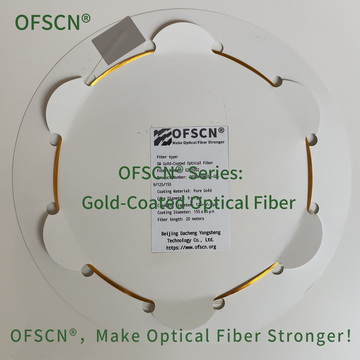
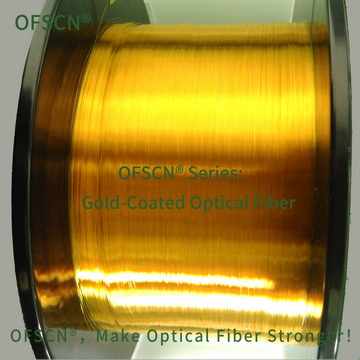
Utilizes a full metallic gold coating. Single-mode operating temperature range is -270\ ^\circ\text{C} to +700\ ^\circ\text{C}, and multimode is -270\ ^\circ\text{C} to +650\ ^\circ\text{C}. - Space Applicability:
The metallic outer layer ensures absolute zero outgassing and resistance to atomic oxygen erosion. It is also available with pure silica core customization, making it suitable for deep space and extreme radiation environments.

3. OFSCN® Fiber Optic Vacuum Sealed Flange
- Parameters:
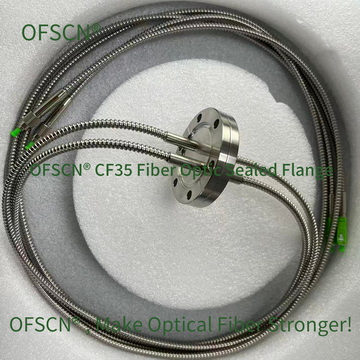
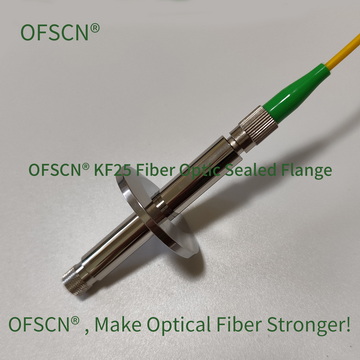
Used for signal feedthrough in spacecraft pressure vessels or ground simulation vacuum chambers (KM chambers). Available in CF and KF flange series, with vacuum capabilities better than 1 \times 10^{-7}\ \text{Pa} and 1 \times 10^{-9}\ \text{Pa} respectively. Customizable options for feedthrough at 250\ ^\circ\text{C} are available.