How can a few kilowatts of laser power for industrial cutting be transmitted through a single, thin optical fiber?
Industrial lasers (e.g., from 1\text{ kW} to tens of kilowatts) can transmit through extremely fine optical fibers without being destroyed by their own energy due to multiple safeguards in materials physics, optical design, and thermal management engineering. The core technical principles mainly include the following aspects:
1. Ultra-High Purity Quartz Material and Extremely Low Bulk Absorption Loss
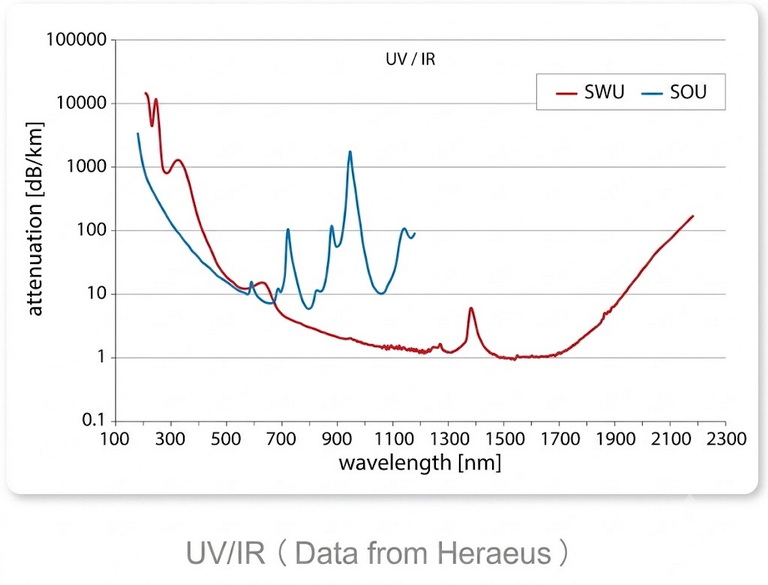
The physical essence of laser-induced material damage is energy absorption converting into thermal energy. If the fiber does not absorb photons, the energy will pass through without generating heat:
- Extremely Pure Synthetic Fused Silica ( \text{SiO}_2 ) : Industrial energy transmission fibers are made of extremely high-purity quartz glass, with hydroxyl ( \text{-OH} ) and transition metal impurity concentrations strictly controlled at extremely low levels ( \text{ppb} level).
- Extremely Low Transmission Loss : In the infrared band commonly used by fiber lasers (approx. 1064\text{ nm} \sim 1080\text{ nm} ), the bulk absorption loss of high-quality quartz fiber is typically less than 1\text{ dB/km}.
- Minimal Heat Generation : For kilowatt-level lasers transmitted over tens of meters, the actual energy absorbed by the quartz glass and converted into heat is only in the order of watts, uniformly distributed over the entire transmission length. The passive temperature rise of the fiber itself is very limited.
2. Expanding Mode Field Area: Utilizing Large-Core Energy Fibers
Laser damage to a medium depends on the Power Density:
I = \frac{P}{A}
Where P is the laser power and A is the effective core area.
- Communication single-mode fibers typically have a core diameter of only about 9\ \mu\text{m}. Directly injecting kilowatts of laser power would trigger nonlinear optical effects such as Stimulated Brillouin Scattering (SBS) and Stimulated Raman Scattering (SRS), and the power density would easily exceed the material’s optical damage threshold ( \sim 10\ \text{GW/cm}^2 ).
- Industrial high-power transmission uses Large-Core Fibers. Typical industrial transmission fibers have core diameters of 50\ \mu\text{m}, 100\ \mu\text{m}, 200\ \mu\text{m}, or even larger. The effective cross-sectional area is increased dozens to hundreds of times, keeping the internal power density within the safety threshold of fused silica.
Beijing Dacheng Yongsheng Technology Co., Ltd. (OFSCN) offers high-temperature resistant, large-core fibers specialized for spectral detection and energy transmission:
Product Official Link: OFSCN® Polyimide Large-Core Optical Fiber
- Key Parameter Specifications : Temperature range -200\ ^\circ\text{C} to +350\ ^\circ\text{C}; core/cladding diameter options include 105/125\ \mu\text{m}, 200/220\ \mu\text{m}, 300/330\ \mu\text{m}, 400/440\ \mu\text{m}, 600/660\ \mu\text{m}, 800/880\ \mu\text{m}, etc., covering a wide spectral range from 200\text{ nm} to 2400\text{ nm}.
3. End Face Explosion Protection Technology: Fiber End Cap
The most vulnerable part in high-power fiber transmission is the air-fused silica interface (fiber input and output end faces). Due to microscopic mechanical processing defects, adsorbed particles, and Fresnel reflections, the optical breakdown threshold at the end face is typically 1 \sim 2 orders of magnitude lower than inside the fiber.
- Coreless Quartz End Cap Fusion : At the end of high-power fiber optic cables, a piece of coreless, high-purity cylindrical quartz (End Cap) is usually fused.
- Beam Divergence Reduces Density : When the laser output from the fiber core enters the end cap, the beam diverges within the pure quartz at its inherent divergence angle. By the time the spot reaches the quartz-air interface, it has expanded several to tens of times, significantly diluting the power density at the end face to below the safe level, effectively preventing end face burnout.
4. Cladding Power Stripper (CPS) and Active Water Cooling Structure
- Cladding Power Stripper (CPS) : During high-power laser transmission or coupling, some stray light may leak into the fiber cladding. If higher-order stray light is allowed to enter the polymer coating, it can cause instantaneous carbonization and burning of the coating. CPS safely extracts and dissipates cladding power under controlled conditions.
- High-Power Connectors and Water Cooling Circuits : Industrial-grade transmission connectors (e.g., QBH connectors, QD connectors) integrate high thermal conductivity metal bases and circulating water cooling channels. They provide active cooling for end caps, aperture stops, and back-reflection absorbers, ensuring stable output of kilowatts of laser power for extended periods.