Can this fiber be directly immersed in water or oil? Will it corrode or degrade over long-term use?

Can this fiber be directly immersed in water or oil? Will it corrode or degrade over long-term use?

For direct immersion in water or oil, the suitability and long-term degradation resistance of the fiber largely depend on the specific fiber type and its packaging. Bare optical fibers with standard coatings may experience degradation over extended periods, especially at elevated temperatures or with certain chemicals present in the oil or water, due to water permeation and potential static fatigue.

To provide you with the most accurate technical solution, could you please specify which type of fiber you are referring to? For example, is it a bare optical fiber or a packaged fiber optic sensor or cable? Additionally, what is the expected temperature range for the immersion?

Packaged fiber optic sensor,about 300℃.

For a packaged fiber optic sensor intended for direct immersion in water or oil at approximately 300°C, the primary concern is the long-term integrity of the encapsulation against high temperature and corrosive media. Standard polymer coatings would degrade under these conditions.

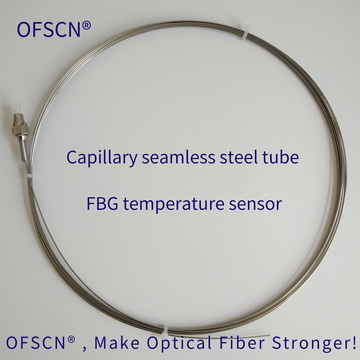
I recommend the OFSCN® 300°C Fiber Bragg Grating Temperature Sensor. This sensor is specifically designed with default single-layer seamless steel tube encapsulation, which offers excellent protection against water, oil, and can withstand temperatures up to 300°C. The robust metal packaging prevents permeation and degradation of the optical fiber itself in harsh environments, ensuring long-term stability and reliability.

Here are the standard images for this product:


You can click the link to view detailed technical parameters. Should you have any specific technical questions, please feel free to continue the discussion.

For a packaged fiber optic sensor requiring direct immersion in water or oil at approximately 300°C, the primary concerns are long-term degradation, corrosion, and the integrity of the packaging.

For this application, we recommend our OFSCN® 300°C Fiber Bragg Grating Temperature Sensor (pictured below), or other OFSCN sensors featuring similar robust encapsulation, such as certain types of strain sensors.


This sensor utilizes a default single-layer seamless steel tube encapsulation technology, which provides excellent hermetic sealing against water and oil ingress, prevents corrosion, and ensures long-term stability and reliability even at 300°C. This robust design eliminates issues like water permeation and static fatigue often associated with bare or inadequately packaged fibers in harsh environments.

You can click the link to view detailed technical parameters. If you have specific technical questions, feel free to discuss further.