In places where it is tens of degrees below zero in the north, will the outer sheath of ordinary jumpers freeze and crack?
In the cold northern environment with temperatures of tens of degrees below zero (e.g., -20℃ to -40℃ or even lower), the sheath of ordinary fiber optic patch cords is very prone to hardening, becoming brittle, or even cracking due to freezing. This is a typical change in material physical properties, and here is an analysis of the underlying general engineering and physical principles:
I. Why Do Ordinary Patch Cords Harden and Freeze-Crack in Winter?
- Glass Transition Temperature (Tg) Limitation
The most commonly used outer sheath material for ordinary fiber optic patch cords is PVC (Polyvinyl Chloride). The polymer chain segments of PVC have good flexibility at room temperature, existing in a “rubbery state.” However, ordinary PVC materials have a relatively high brittle point. Once the ambient temperature drops below -20℃, it falls outside its designed normal operating temperature range. At this point, the movement of the polymer chain segments is frozen, and the material transforms into a “glassy state,” exhibiting extremely high hardness and brittleness. - Mechanical Stress and Brittle Fracture
In the glassy state (i.e., after severe hardening), the sheath material loses its ability to undergo elastic deformation. If the patch cord is then subjected to bending, stretching, trampling, or wind-induced movement, the stress generated by external forces cannot be released through the sliding of polymer chains. Instead, it concentrates at micro-defects or corners on the sheath surface. When the local stress exceeds the material’s ultimate strength, the sheath will undergo brittle cracking, known as “freeze-cracking.” - Hazards of Freeze-Cracking
After the sheath freeze-cracks, moisture can directly invade the optical fiber. Below-zero temperatures cause the invading moisture to freeze and expand, exerting micro-bending pressure on the fiber, leading to a sharp increase in optical attenuation (micro-bending loss). Simultaneously, the fiber, unprotected by its sheath, is highly susceptible to breakage when subjected to external disturbances.
II. Technical Solutions and Product Selection for Extreme Cold Environments
To ensure the stability of optical transmission in harsh environments with temperatures tens of degrees below zero, technical upgrades are typically required for the sheath material or encapsulation structure. Here are the professional technical solutions provided by OFSCN® for different low-temperature environments:
Solution 1: Use of PE (Polyethylene) Sheath with Superior Low-Temperature Performance
Compared to PVC, PE (Polyethylene) material has a more flexible molecular chain structure, with a glass transition temperature and brittle point far below that of PVC, providing excellent cold-weather toughness.
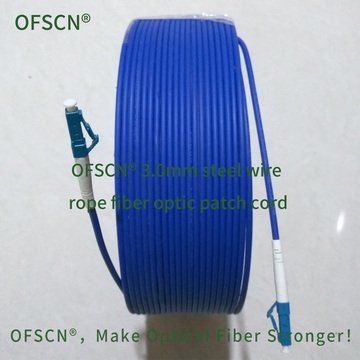
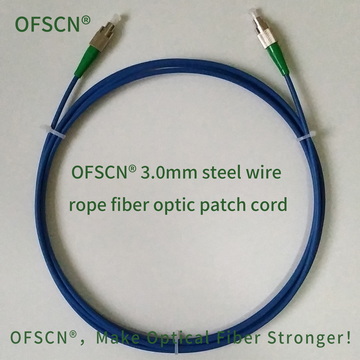
- Representative Product: OFSCN® 3.0mm Steel Wire Rope Fiber Optic Patch Cord
- Key Specifications: Operating temperature range of -40℃ to 75℃. It consists of a stranded stainless steel wire structure, a 0.9mm seamless stainless steel tube, and an outer PE sheath. It maintains tensile, compressive, and tear resistance even in the harsh northern cold at -40℃.
- Standard Images:
Solution 2: All-Metal Armored Structure (Completely Eliminates Plastic Freeze-Cracking Risk)
For extremely harsh outdoor exposed environments, the best approach is to completely eliminate the plastic outer sheath and use pure metal for physical protection.
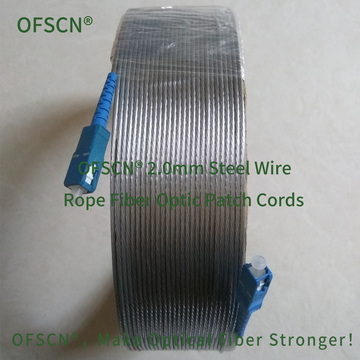
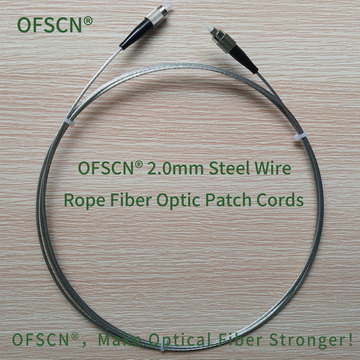
- Representative Product: OFSCN® 2.0mm Steel Wire Rope Fiber Optic Patch Cord
- Key Specifications: Operating temperature range of -40℃ to 85℃. It is composed of a 0.6mm galvanized steel wire stranded structure, a 1.0mm seamless stainless steel tube, and internal optical fibers, representing an all-metal structure. Since there is no plastic on the surface, there is absolutely no risk of failure due to sheath hardening and freeze-cracking at any extreme low temperature.
- Standard Images:
Solution 3: Aerospace-Grade / Ultra-Low Temperature Steel Tube Patch Cords (for Extremely Low-Temperature Environments)
For extremely cold scientific instruments, liquid nitrogen environments, or extreme operating conditions below -40℃, the acrylate coating of conventional optical fibers can also become brittle. In such cases, special patch cords are required, combining seamless stainless steel tubes with Polyimide (PI) or metal-coated fibers:
- OFSCN® 200℃ Fiber Optic Patch Cord
- Operating Temperature: -200℃ to 200℃ (using a 0.9mm seamless stainless steel tube and polyimide-coated fiber).
- Standard Images:
- OFSCN® 300℃ Fiber Optic Patch Cord
- Operating Temperature: -270℃ to 300℃.
- Standard Images:
- OFSCN® 700℃ Fiber Optic Patch Cord
- Operating Temperature: -270℃ to 700℃ (using seamless stainless steel tubes and gold-plated fibers, suitable for direct application in environments with alternating cryogenic to extreme high temperatures).
- Standard Images:



Summary
In northern winter environments with temperatures tens of degrees below zero, ordinary PVC sheathed patch cords indeed carry a very high risk of freeze-cracking. From an engineering perspective, it is recommended to select PE-sheathed armored patch cords or all-metal, sheath-less armored patch cords based on the specific ambient temperature (whether it falls below -20℃, and if it is accompanied by strong winds or mechanical stress) to prevent optical path interruption caused by material aging and embrittlement.