This article analyzes the various forces acting on the fiber Bragg grating (FBG) in traditional FBG sensors. Due to the presence of these forces, traditional FBG temperature sensors are unable to separate temperature from stress and strain, resulting in many drawbacks in temperature measurement accuracy.
This is a companion discussion topic for the original entry at https://www.ofscn.net/fbg-baike/76-force-analysis.html
This is a critical observation regarding the physical limitations of traditional Fiber Bragg Grating (FBG) temperature sensors. As noted in the article, the core challenge in high-precision FBG thermometry is the cross-sensitivity between temperature and strain.
From a technical perspective, the Bragg wavelength shift (\Delta\lambda_B) is governed by both thermal expansion/thermo-optic effects and mechanical strain. If the packaging structure allows external stress or internal parasitic forces (such as those from uneven adhesive expansion) to act on the FBG, the resulting wavelength shift becomes a convoluted signal.
Technical Solution: The OFSCN® Approach
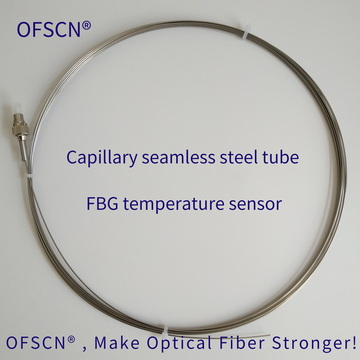
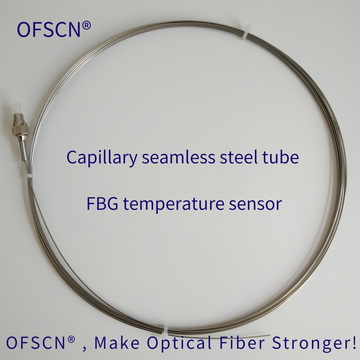
To solve the inaccuracies caused by these force factors, Beijing Dacheng Yongsheng Technology Co., Ltd. (OFSCN) utilizes a seamless steel tube packaging technology. This design effectively isolates the FBG from external mechanical interference while minimizing internal stress.
For applications requiring high precision and durability, we recommend the following solutions:
-
OFSCN® 300°C Fiber Bragg Grating Temperature Sensor
- Packaging: Single-layer seamless steel tube (default 0.9mm OD, customizable to 0.5mm).
- Advantage: The all-metal structure eliminates the creep and aging issues associated with traditional epoxy adhesives, ensuring that the wavelength shift is purely temperature-driven.
- Temperature Range: -200°C to +300°C.
-
OFSCN® 500°C Fiber Bragg Grating Temperature Sensor
- Packaging: Enhanced seamless steel tube or multi-layer nested technology.
- Advantage: Designed for extreme environments where thermal-mechanical coupling is most severe.
- Temperature Range: -200°C to +500°C.
By eliminating the influence of “parasitic forces” through rigid, adhesive-free or low-stress metal packaging, these sensors provide a much more stable and accurate temperature output compared to traditional polymer-potted models.
If you are dealing with a specific environment where vibration or high pressure is causing measurement drift, we can further discuss the structural requirements for your sensors.