In nuclear physics experiments or strong electromagnetic environments, how do jumpers protect signals?
In nuclear physics experiments, high-power impulse devices (such as Z-pinch, Tokamak devices), or electromagnetic pulse (EMP) environments, the rate of change of electromagnetic fields is extremely high ( dE/dt and dB/dt are very large). Traditional copper wires and coaxial cables will generate enormous induced electromotive forces and transient surge currents due to severe antenna effects, completely destroying electrical signal transmission.
Leveraging the properties of optics and condensed matter physics, fiber optic patch cords protect measurement and transmission signals in such environments through the following mechanisms:
I. Signal Protection Principles at the Physical Layer
-
Inherent Electromagnetic Immunity and Zero Induction
- Physical Medium: The core wave-guiding medium of a fiber optic patch cord is high-purity silica glass ( \text{SiO}_2 ), which is an isotropic, non-polar dielectric with a resistivity typically exceeding 10^{14}\ \Omega\cdot\text{cm}.
- Zero Coupling: The carrier transmitted in optical fibers is light waves with wavelengths in the near-infrared region (e.g., 850\text{ nm} , 1310\text{ nm} , 1550\text{ nm} ). Their photons are uncharged. Within the framework of Maxwell’s equations, strong external transient electromagnetic fields (including HEMP generated by high-altitude nuclear explosions, with field strengths potentially exceeding 50\ \text{kV/m} ) do not exert Coulomb or Lorentz forces on the charge-free photon stream, thus preventing induced voltages, surge currents, or waveform distortions in the optical signal within the patch cord.
-
Ground Loop Isolation and Potential Difference Mitigation
- During the instantaneous discharge in nuclear physics experiments or EMP bursts, transient ground potential differences (Ground Potential Rise / Ground Bounce) of hundreds of kilovolts to megavolts often exist between the experimental site and the control room.
- The use of metal-free fiber optic patch cords (all-dielectric construction) provides complete electrical isolation, severing the physical conduction path between high and low voltage grounds, and preventing high-voltage ground currents from entering sensitive terminal demodulation and acquisition equipment.
-
Material Reinforcement Against Associated Radiation (Radiation-Induced Attenuation, RIA)
- Nuclear physics experiments are often accompanied by strong transient radiation (neutron flux and \gamma rays). High-energy particles can create color center defects in ordinary germanium-doped ( \text{Ge} ) silica lattices, leading to Radiation-Induced Attenuation (RIA).
- In areas with high radiation fields, the fiber core typically employs a Pure Silica Core Fiber (PSCF), combined with radiation-resistant coatings like Polyimide, to minimize the sudden increase in optical loss caused by lattice damage.
II. Patch Cord Structure Selection and Engineering Protection
In the practical application of high electromagnetic field and nuclear physics engineering, patch cord material and structure need to be matched to specific operating conditions:
-
High Field Discharge / High Voltage Breakdown Risk Zone: All-Dielectric Patch Cords
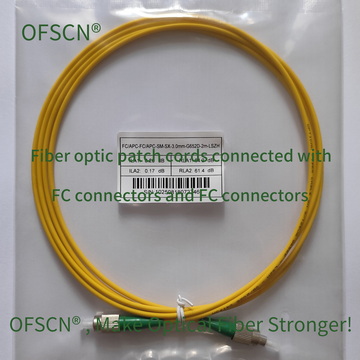
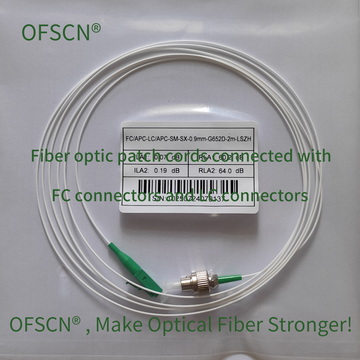
When the environment involves risks of arcing, extremely high electrostatic fields, or microwave ionization, the patch cord should avoid any conductive metal jacketing layers. It should utilize high-insulation patch cords reinforced with aramid yarn (Kevlar) to eliminate induced eddy currents and discharge breakdown paths associated with metal jacketing.- Matching Product: OFSCN® Standard Fiber Patch Cord
- Structural Parameters: Utilizes optical fiber, aramid fiber for tensile strength, and an insulating polymer outer jacket (all-dielectric configuration, standard outer diameter 3.0\text{ mm} , customizable to 2.0\text{ mm} or 0.9\text{ mm} ).
-
High Impact / High Temperature Physical Conditions: Micro-Armored and Special Coating Patch Cords
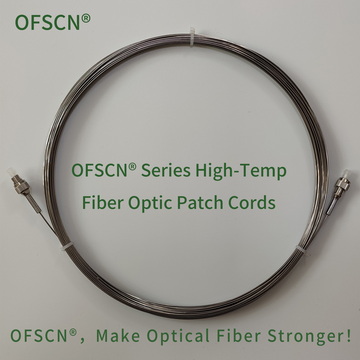
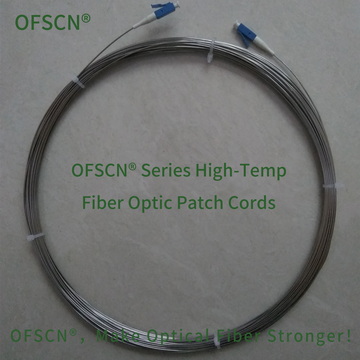
If the environment simultaneously involves extreme mechanical impact, strong vibration, or high temperatures, stainless steel seamless micro-tubing protection for the fiber optic patch cord is required. When using metallic micro-armored patch cords in EMP environments, the outer metal tube must be reliably single-point grounded or its shielding continuity ensured, allowing it to function as a Faraday shield while protecting the internal optical fiber core from high-temperature or mechanical damage.- Matching Product: OFSCN® 300℃ Fiber Optic Patch Cord
- Structural Parameters: Operating temperature range covers -270^\circ\text{C} to 300^\circ\text{C} , utilizing 0.9\text{ mm} stainless steel seamless steel tubing with a special polyimide-coated optical fiber (pure silica core fiber can be customized).