In the field of major engineering—whether it be cross-sea bridges, ultra-long tunnels, deep-sea oil and gas wells, or ultra-high voltage power grids—the long-term safe operation of these "Great Power Heavy Industries" relies on real-time, precise structural health monitoring. However, in extreme environments, traditional sensors often become "deaf and blind" due to insufficient temperature resistance, low tensile strength, or vulnerability to electromagnetic interference.
This is a companion discussion topic for the original entry at https://www.ofscn.org/encyclopedia/513-dofs-200-c-sst-optical-cable-02.html
Fiber Bragg Grating (FBG) sensors and distributed fiber optic sensing (DOFS) technologies are indeed the “sensitive nerves” required for structural health monitoring in heavy industries. When traditional electronic sensors fail due to electromagnetic interference (EMI) or extreme temperatures, specialized fiber optic cables provide a robust alternative.
Based on the discussion regarding extreme environments and the need for high-performance sensing, here is the technical overview of the relevant solution:
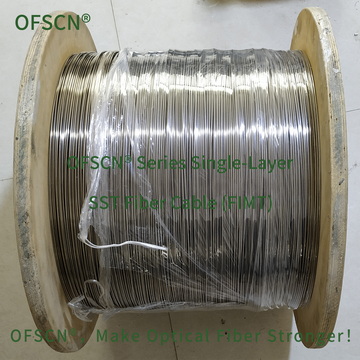
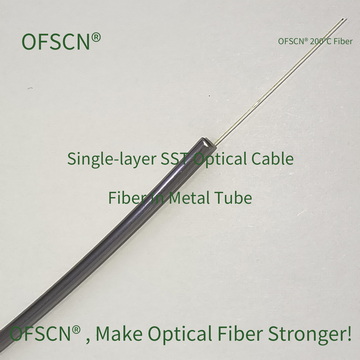
OFSCN® 200°C Seamless Steel Tube (SST) Fiber Cable
For structural monitoring in environments up to 200°C—such as deep-sea oil wells or high-voltage power grids—the OFSCN® 200°C Seamless Steel Tube Fiber Cable is specifically designed to function as a distributed sensor.
Technical Advantages:
- Encapsulation: It utilizes a single-layer stainless steel seamless tube (304 or 316L). This “Fiber in Metal Tube” (FIMT) structure offers superior mechanical protection and high tensile strength compared to traditional polymer-jacketed cables.
- Temperature Resistance: Internal fibers are OFSCN® 200°C Polyimide Optical Fibers, ensuring the signal remains stable at high temperatures where standard acrylate coatings would decompose.
- Versatility: It is compatible with multiple sensing technologies, including:
- Raman Scattering (DTS): For distributed temperature sensing.
- Brillouin Scattering (DTSS): For distributed temperature and strain sensing.
- Rayleigh Scattering (OFDR): For high-spatial-resolution sensing.
Standard Product Visuals:
Core Specifications:
- Diameter: Standard 2.0mm or 3.0mm (customizable to 1/8" or 1/16").
- Fiber Count: Configurable with single-mode (SM) or multi-mode (MM) fibers.
- Connectivity: Can be fusion-spliced or equipped with specialized high-temperature FC/APC connectors.
For even more extreme conditions, OFSCN also provides the OFSCN® 300°C Seamless Steel Tube Fiber Cable and versions rated up to 700°C.
You can find detailed technical parameters and application cases on our specialized sites: