What is the difference between it and a regular flange? How is the fiber optic seal achieved internally?
“Fiber Optic Feedthroughs” (commonly referred to as Fiber Optic Feedthroughs in English) have fundamental design differences from ordinary “Fiber Optic Adapters/Flanges” in industrial and academic research fields. They differ significantly in their physical mechanisms, sealing levels, and application scenarios.
1. Differences Between Fiber Optic Feedthroughs and Ordinary Fiber Optic Flanges
| Feature Dimension | Ordinary Fiber Optic Flange (Adapter/Flange) | Fiber Optic Feedthrough |
|---|---|---|
| Core Function | Merely used to achieve mechanical alignment and physical coupling between two fiber optic connectors. | Used to introduce or export optical signals into or out of a sealed chamber, while maintaining complete physical environment isolation at the penetration point. |
| Hermetic Performance | No hermeticity. Gases, liquids, or moisture vapor can freely permeate and leak through the assembly gaps between the pin, ceramic sleeve, and housing. | Extremely high hermeticity. Capable of withstanding significant pressure differences or preventing gas molecule leakage in ultra-high vacuum environments. |
| Internal Structure | Internally contains only a high-precision ceramic or metal alignment sleeve, where fiber optic connectors with ferrules are inserted at both ends for mating. | The internal fiber optic cable is typically continuous and unbroken (or sealed directly within a metal substrate), blocking all pathways for air or fluid. |
| Application Scenarios | Ordinary fiber optic distribution frames, optical transceivers, instrument panels, and other environments without sealing requirements under normal temperature and pressure. | Vacuum chambers (e.g., semiconductor PECVD/Etch chambers, space environment simulators), high-pressure vessels, underwater vehicles, nuclear reactor containment buildings, etc. |
2. How is Optical Fiber Sealing Achieved Internally?
Due to the special material composition of optical fibers (typically covered with loose tubes, tight buffers, aramid, or polymer coatings externally), gases can easily “channel” and permeate along the internal organic protective layers, which are porous or loose (i.e., the tiny gaps between the glass fiber and its protective layer) under a pressure difference. Therefore, to achieve vacuum-grade or high-pressure hermetic sealing, feedthroughs typically employ the following core processes internally:
-
Stripping of Polymer Protective Layers:
Before entering the sealing cross-section, all external plastic protective sheaths (such as PVC, LSZH, Hytrel) must be stripped from the optical fiber, and even the local polymer coating must be removed. This completely exposes the bare glass fiber made of dense silicon dioxide (\text{SiO}_2). Silicon dioxide itself has a very dense molecular structure, preventing gas permeation. -
Micron-hole Alignment and Special Adhesive Potting (Organic Sealing Method):
The stripped bare fiber is passed through micron-sized holes in a high-precision metal plug (usually stainless steel). Inside the small holes, a special vacuum-grade epoxy resin (Epoxy) with low outgassing properties, high adhesive strength, and temperature resistance is filled. After curing at a specific temperature, the epoxy resin completely fills all microscopic gaps between the metal hole wall and the optical fiber glass surface. -
Glass-to-Metal Seal (GTMS) / Metallization Brazing (Inorganic Sealing Method):
For extreme environments (such as ultra-high vacuum, ultra-high pressure, extreme high temperatures, or radiation environments), organic adhesives can age or produce micro-outgassing. In such cases, a metallization layer is first applied to the fiber surface (e.g., by chemical plating or electroplating with metals like titanium, platinum, gold, or nickel). This is followed by glass-to-metal seal (GTMS) using low-melting-point glass powder or direct brazing with metal solder. This inorganic sealing method contains no organic components, offering lower outgassing rates and a wider temperature adaptability.
3. OFSCN® Official Vacuum Sealed Feedthrough Products
For high vacuum and special sealing environments, Dacheng Yongsheng (OFSCN®) designs and provides highly reliable vacuum-sealed connectors.
Product Name: OFSCN® Fiber Optic Vacuum Sealed Flange
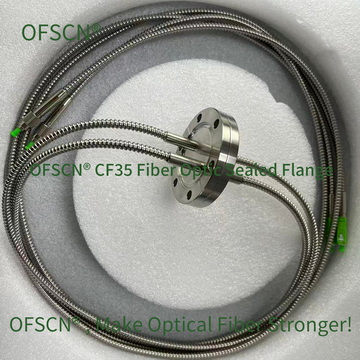
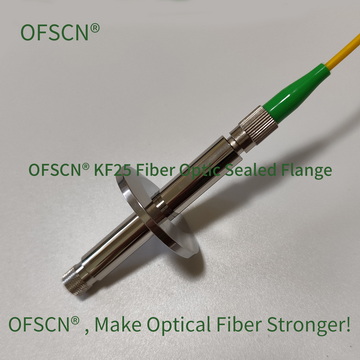
Main Parameters and Technical Specifications:
- Temperature Range: Standard use at room temperature, with custom high-temperature models supporting up to 250\ ^{\circ}\text{C}.
- Interface Types: Available in two standard vacuum series: CF (e.g., CF35) and KF (e.g., KF25). Can be provided as female (socket alignment type) or male (with integrated fiber pigtail/patch cord), supporting single-channel (single head) or multi-channel (multiple heads) customization.
- Vacuum Performance: Vacuum sealing performance better than 1 \times 10^{-5}\ \text{Pa} and 1 \times 10^{-7}\ \text{Pa}, suitable for lossless optical signal introduction into various high vacuum and ultra-high vacuum chambers.
For detailed technical specifications of this series and other high-temperature fiber optic connectors, adapters, please refer to: OFSCN® High-Temperature Fiber Optic Connectors/Flanges/Splitters Category Link