In multi-fiber cables, how are different fibers quickly identified via color?
In multi-fiber cables, different fibers are quickly identified using a standardized color coding scheme, typically following TIA/EIA-598-D (or similar international standards). This scheme helps in organizing and identifying individual fibers within a larger cable structure during installation, termination, and maintenance.
For cables with up to 12 fibers, the fibers are color-coded in a specific sequence:
- Blue
- Orange
- Green
- Brown
- Slate (Grey)
- White
- Red
- Black
- Yellow
- Violet (Purple)
- Rose (Pink)
- Aqua (Turquoise)
For cables containing more than 12 fibers, these 12 colors are repeated. To differentiate between groups, a secondary identification method is used, such as a binder thread or a tracer stripe on the fiber coating itself. For example, a 24-fiber cable might have two groups of 12 fibers. The first group would be the standard 12 colors, and the second group would be the same 12 colors but with a distinguishing mark, often a white stripe or a different colored binder thread.
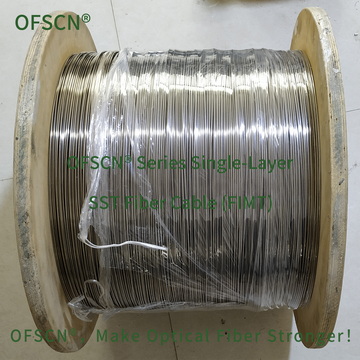
OFSCN provides various OFSCN® Seamless Steel Tube Fiber Cables that can accommodate multiple optical fibers for diverse applications. These robust cables are designed for harsh environments, ensuring reliable performance where clear fiber identification is crucial.
Here is an example image of a seamless steel tube fiber cable: