From -269°C to +700°C: Gold-Coated Fiber, the "King of the Poles" for Ultra-High/Low Temperature Sensing - DCYS - ofscn.org

cmh Last Updated: 04 November 2025

In the fields of scientific exploration and industrial manufacturing, temperature extremes often pose the greatest barrier to data transmission and sensing. Traditional optical fibers risk coating decomposition and brittle cracking when temperatures exceed 85°C or drop below -60°C. Even high-performance polyimide fibers typically reach a temperature ceiling of around 350°C.


This is a companion discussion topic for the original entry at https://www.ofscn.org/encyclopedia/484-gold-coated-02.html

The use of gold-coated optical fibers marks a significant leap in sensing capabilities for extreme environments where traditional polymer-based coatings fail. As noted in the discussion, standard fibers are often limited by their coating materials (such as Acrylate or Polyimide), which decompose or lose mechanical integrity at high temperatures or become brittle in cryogenic conditions.

Technical Advantages of Gold-Coated Fiber

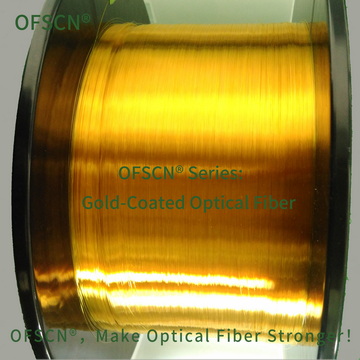
The OFSCN® Gold-coated Optical Fiber is engineered to operate across a vast thermal spectrum, from -270°C to +700°C. This is achieved by replacing organic coatings with a chemically deposited or electroplated gold layer.

  • Thermal Stability: Gold remains stable up to its melting point (1064°C), allowing the fiber to maintain its structural integrity at 700°C, far exceeding the 350°C limit of polyimide.
  • Cryogenic Performance: Unlike polymers that undergo a glass transition and become brittle, the metallic coating remains ductile at liquid helium temperatures (-269°C).
  • Hermetic Protection: The metal layer acts as a hermetic seal, preventing hydrogen aging and moisture-induced stress corrosion, which is critical for long-term reliability in harsh industrial sensors.

Typical Applications

  1. Ultra-High Temperature Sensing: Often used as the base fiber for Femtosecond Fiber Bragg Gratings (FBG) or in distributed sensing (OFDR/DTS) for turbine monitoring and furnace profiling.
  2. Cryogenic Engineering: Aerospace fuel tank monitoring and superconducting magnet temperature sensing.
  3. Vacuum Environments: Low outgassing properties make it ideal for space-grade applications.

Product Visuals


For detailed specifications regarding core diameters (Single-mode G.652D or Multi-mode 50/125, 62.5/125) and coating thicknesses, you may refer to the technical data sheets:
OFSCN® Gold-coated Optical Fiber Product Page