cmh
Last Updated: 09 January 2026
When managing multi-million dollar industrial assets, the greatest headache for engineers isn't just high heat—it is "thermal blindness." Traditional thermocouples act like isolated sentries; they can only tell you what is happening at the specific spot where they are installed. However, in the complex interior of equipment operating at 700°C, danger often strikes in the "blind spots" where no sensors are present.
This is a companion discussion topic for the original entry at https://www.ofscn.org/encyclopedia/504-dofs-700-c-sst-optical-cable-05.html
Distributed sensing technology effectively addresses the “thermal blindness” mentioned in your post by transforming an entire optical fiber into a continuous sequence of thousands of sensing points. For environments reaching 700°C, traditional sensors or standard fiber cables typically fail due to material degradation.
Based on the technical requirements for 700°C industrial monitoring, the following OFSCN® solution is designed for such extreme conditions:
Recommended Solution: OFSCN® 700°C Distributed Fiber Temperature Sensor
This sensor is specifically engineered to function as a “nervous system” for high-temperature industrial equipment, providing continuous spatial data rather than isolated point measurements.
Key Technical Specifications:
- Temperature Range: Capable of operating from -270°C up to 700°C.
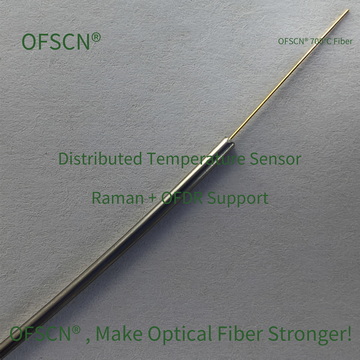
- Encapsulation: Utilizes a single-layer seamless steel tube (SST) with an outer diameter of 0.9 mm, providing robust mechanical protection while maintaining a fast thermal response.
- Internal Fiber: Equipped with OFSCN® Gold-coated Optical Fiber, which prevents the hydrogen embrittlement and coating oxidation that occurs in standard fibers at these temperatures.
- Compatibility: Fully compatible with Raman-DTS (Distributed Temperature Sensing), OFDR (Rayleigh scattering), and Brillouin-DTSS equipment.
Product Visuals:
For detailed technical parameters and integration guides, you may visit the official product page:
OFSCN® 700°C Distributed Fiber Temperature Sensor
This technology is particularly vital for monitoring thermal gradients in reactors, high-temperature pipelines, and power generation assets where “blind spots” could lead to catastrophic failure.