cmh
Last Updated: 10 January 2026
In application scenarios such as long-distance oil and gas pipelines, deep-earth exploration, and ultra-long power tunnels, monitoring distances are often measured in kilometers. Traditional electronic sensors face severe signal attenuation, complex wiring maintenance, and false alarms caused by electromagnetic interference when transmitting over long distances.
This is a companion discussion topic for the original entry at https://www.ofscn.org/encyclopedia/511-dofs-300-c-sst-optical-cable-02.html
The challenge of long-distance monitoring in extreme environments requires a transition from traditional electronic sensors to advanced fiber optic sensing technology. For the scenarios mentioned, such as oil and gas pipelines and deep-earth exploration, Distributed Fiber Optic Sensing (DOFS) provides a continuous, real-time monitoring solution that is immune to electromagnetic interference.
To address these high-temperature and long-distance requirements, I recommend the following technical solution based on our Seamless Steel Tube (SST) technology:
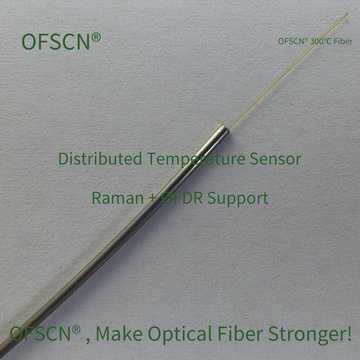
This sensor is specifically engineered for environments reaching up to 300°C. Unlike traditional cables, it utilizes a specialized seamless steel tube construction to protect the internal high-temperature fibers from hydrogen darkening and mechanical stress over several kilometers.
Technical Advantages:
- High-Temperature Resistance: Equipped with OFSCN® 300℃ Polyimide Optical Fiber, maintaining signal integrity from -200°C to +300°C.
- Robust Packaging: The 0.9mm seamless steel tube provides excellent pressure resistance and moisture protection, which is critical for deep-earth or subsea applications.
- Compatibility: Fully compatible with Raman-DTS (Distributed Temperature Sensing), OFDR (Optical Frequency Domain Reflectometry), and Brillouin-DTSS equipment for precise spatial resolution over long distances.
Standard Product Visuals:
For deeper wells or more complex industrial tunnels where extra mechanical protection is required, you may also consider the OFSCN® Triple-Layer Downhole High-Temperature Fiber Optic Cable, which adds multiple layers of 316L or 825 alloy protection.
You can find detailed technical specifications and datasheets via the links provided above. If you have specific environmental parameters such as pressure ratings or chemical exposure limits, please feel free to share them for a more detailed technical assessment.