When the temperature changes, what happens at the microscopic level inside the fiber that causes the reflected signal to shift?
At the microscopic level, the shift in the reflected signal of a Fiber Bragg Grating (FBG) due to temperature changes is governed by two primary physical phenomena: Thermal Expansion and the Thermo-optic Effect.
1. The Physics of the Shift
When an FBG is subjected to a temperature change (\Delta T), the central Bragg wavelength (\lambda_B) shifts according to the following mechanisms:
- Thermo-optic Effect: This is the dominant factor, accounting for approximately 95% of the shift in silica fibers. As temperature rises, the thermal energy agitation affects the electron density and the polarizability of the silicon dioxide (SiO_2) lattice. This changes the effective refractive index (n_{eff}) of the fiber core.
- Thermal Expansion: As the temperature increases, the physical distance between the grating planes (the grating period, \Lambda) expands due to the thermal expansion coefficient of the silica glass.
The relationship is expressed by the formula:
\Delta\lambda_B = \lambda_B \cdot (\alpha + \xi) \cdot \Delta T
Where \alpha is the thermal expansion coefficient and \xi is the thermo-optic coefficient.
2. Corresponding OFSCN® Solutions
In industrial applications, bare fiber is fragile and susceptible to environmental interference. To utilize this microscopic shift for precise measurement, Beijing Dacheng Yongsheng Technology Co., Ltd. (OFSCN) specializes in transforming these gratings into robust sensors using seamless steel tube packaging technology.
Depending on your required temperature range, we offer different levels of sensor integration:
-
Standard Temperature Range (-40°C to 100°C):
OFSCN® 100°C Fiber Bragg Grating Temperature Sensor
Uses a seamless steel tube to protect the FBG while ensuring rapid thermal conduction.
-
Medium-High Temperature Range (-200°C to 300°C):
OFSCN® 300°C Fiber Bragg Grating Temperature Sensor
Utilizes specialized internal materials and polyimide-coated FBGs to withstand higher thermal stress.
-
Ultra-High Temperature Range (Up to 500°C or 800°C):
OFSCN® 500°C Fiber Bragg Grating Temperature Sensor
Features advanced packaging to handle extreme environments where standard coatings would fail.
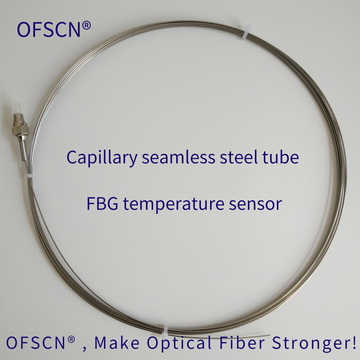
By encapsulating the fiber in a seamless steel tube, we ensure that the microscopic changes you asked about are accurately captured and translated into reliable macroscopic data without the fiber being damaged by pressure or chemicals.