Can jumper wires be cut and reconnected like electrical wires? What if they are too long?
Fiber optic patch cords must never be cut and manually twisted together like copper wires.
Here is a systematic analysis from the perspectives of physical transmission mechanisms, splicing methods, and engineering handling of excessively long patch cords:
I. Physical Mechanism: Why Can’t Fiber Optic Cables Be Cut and Twisted Arbitrarily Like Electrical Wires?
-
Fundamental Differences in Transmission Medium and Mechanism
- Electrical Wires (Copper Wires): Conduct electricity through the drift of free electrons within the metal. When a wire is cut, simply stripping, twisting, or soldering can ensure electron flow and maintain circuit continuity (introducing only minor contact resistance).
- Fiber Optic Patch Cords: Transmit light via total internal reflection, relying on the difference in refractive index between the core and cladding of the quartz glass fiber. For standard single-mode fiber, the core diameter is only about 9\ \mu\text{m} , and the cladding diameter is 125\ \mu\text{m} . Light propagates in the core at specific wavelengths (e.g., 1310\text{nm} or 1550\text{nm} ).
-
Destruction of Optical Properties by Cutting
- Using ordinary scissors to cut a fiber optic cable will cause irregular fragmentation and cracks in the quartz glass core, completely destroying the geometric end face.
- Attempting to directly twist or squeeze two cut fiber ends together will result in severe axial misalignment and angular deviation of the micron-level core. Light waves will experience intense Fresnel scattering and insertion loss at the fractured end face, leading to a complete failure of signal transmission (optic path interruption).
II. If a Fiber Optic Patch Cord is Broken or Must Be Spliced, How Should It Be Handled?
If a fiber optic patch cord suffers physical damage or needs to be cut and re-spliced, professional optical engineering equipment must be used for precision handling:
- Fusion Splicing: Use stripping tools to remove protective jackets and coatings, clean the fiber with high-purity anhydrous alcohol, use a precision fiber cleaver to create a flat 90^\circ perpendicular end face, then place it in a fiber fusion splicer. After micron-level optical alignment, apply an electric arc discharge to fuse the two quartz glass ends together, and cover with a heat-shrink protective sleeve.
- Re-fabricating Connectors/Splicing Pigtails: Since fiber optic patch cords are equipped with precision ceramic ferrule connectors (e.g., FC/APC, LC/PC) at both ends, if a connector is damaged, it is usually necessary to cut it and splice in a pigtail with a factory-grade polished end face, or use an on-site mechanical splice (cold connector).
III. Standard Engineering Methods for Handling Overly Long Fiber Optic Patch Cords
In actual cabling and experimental setups, if a patch cord is longer than the actual required distance, the following standard procedures should be followed:
-
Proper Cable Coiling (Winding)
- Neatly coil the excess fiber optic patch cord in a circular or “8” shape within patch panels, cable management boxes, or winding troughs.
- Bending Radius Limitation: Strict adherence to the minimum bending radius is required during coiling. The long-term bending radius for standard single-mode fiber (e.g., G.652D) should generally be maintained above 30\text{mm} . Avoid sharp right-angle bends, tight knots, or excessive squeezing of the fiber optic patch cord, as this can cause severe macro-bending loss or lead to internal fiber core breakage.
-
Customizing Standard Lengths as Needed
- During the engineering design or procurement phase, precisely measure the physical routing distance between equipment and directly order patch cords of the appropriate length.
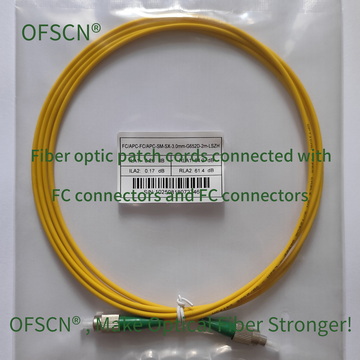
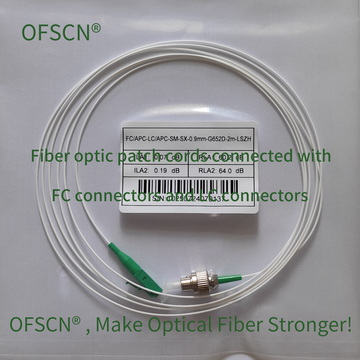
In the Beijing Dacheng Yongsheng Technology Co., Ltd. (OFSCN®) product line, fiber optic patch cords support complete length customization services from 10\text{cm} to several hundred meters, effectively avoiding issues with redundant or overly long patch cords causing coiling difficulties at the source. For example, the OFSCN® Standard Fiber Patch Cord uses standard PC/APC precision polished ferrules and robust protective jackets, suitable for optical connections in laboratories and industrial field sites. More patch cord specifications can be found in the OFSCN® Fiber Patch Cords Products.