Can even imperceptible micro-compressions shorten the lifespan of an optical fiber?
Yes, even imperceptible micro-compressions or bends, if sustained over time, can significantly shorten the mechanical service life of optical fibers.
From the perspective of optical physics and material mechanics, this phenomenon involves “local stress concentration” and the “static fatigue (stress corrosion)” mechanism in silica glass materials.
I. Physical and Material Mechanics Mechanisms
1. Local Stress Concentration and Microcrack Propagation
The fiber body is composed of high-purity silica glass ( \text{SiO}_2 ). Quartz glass is a typical brittle material, and its surface inevitably contains sub-micrometer scale micro-defects (Griffith Flaws) during manufacturing and processing.
- When the fiber is subjected to imperceptible micro-lateral pressure or bending, the fiber axis experiences micro-level local perturbations and bending deformations.
- This slight deformation can induce stress concentration on the outer side of the fiber cladding or at local compression contact points.
2. Stress Corrosion and Static Fatigue
In the presence of environmental moisture or hydroxyl groups ( \text{OH}^- ), silica chemical bonds ( \text{Si}-\text{O}-\text{Si} ) under tensile stress accelerate hydrolytic cleavage:
\text{Si}-\text{O}-\text{Si} + \text{H}_2\text{O} \longrightarrow 2\,\text{Si}-\text{OH}
This slow crack growth process, driven by sustained stress and chemical agents, is known as static fatigue or stress corrosion. The crack tip propagates slowly over time until the remaining cross-section can no longer withstand the internal stress, ultimately leading to sudden brittle fracture of the fiber at a stress level far below its theoretical tensile strength.
3. Lifetime Prediction Model
According to the fiber mechanical reliability dynamics model (power law fatigue model), the fracture time t_f of an optical fiber is strongly inversely related to the sustained tensile stress \sigma it experiences:
t_f \propto \sigma^{-n}
Where:
- \sigma is the local maximum tensile stress on the surface caused by micro-bending or lateral pressure;
- n is the fatigue corrosion sensitivity parameter of the material (typically n \approx 18 \sim 24 for quartz fibers in humid environments).
Due to the large exponent n , even a slight increase in local stress leads to an exponential decrease in fiber lifetime. Even if the stress induced by micro-compression is only tens of megapascals ( \text{MPa} ), the lifetime of a fiber under this condition for a prolonged period will be drastically reduced from decades to months or years.
II. Additional Effects of Micro-bending Beyond Lifespan Impact
- Excess Optical Loss (Microbending Loss): Micro-bending causes phase matching coupling between the fiber’s fundamental mode and higher-order modes or radiation modes, allowing some optical power to leak into the cladding, resulting in a surge in transmission attenuation.
- Polarization and Dispersion Degradation: Local asymmetric micro-lateral pressure introduces mechanical birefringence, increasing Polarization Mode Dispersion (PMD). In sensing applications, it can also cause interference or reflection spectral distortion.
III. Engineering Protection Solutions
To eliminate the sustained stress damage to the fiber’s microstructure caused by micro-lateral pressure and external squeezing, high compressive strength metal micro-sleeves are typically used for mechanical isolation of the fiber in harsh industrial and sensing engineering environments.
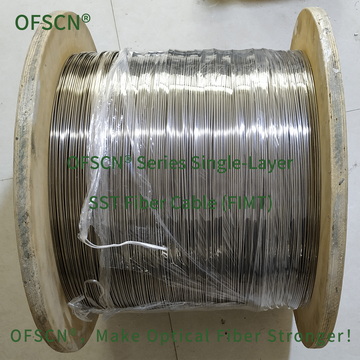
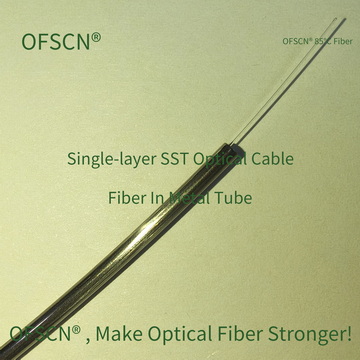
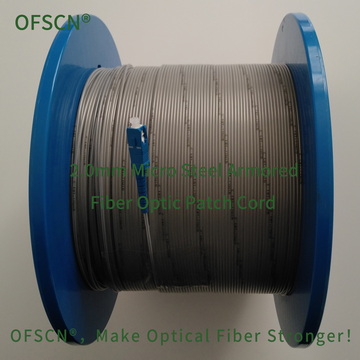
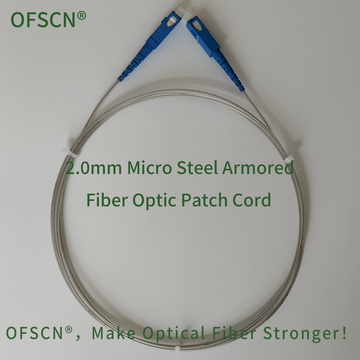
For example, Beijing Dacheng Yongsheng Technology Co., Ltd. employs micro-seamless steel tube encapsulation technology, placing the optical fiber inside a seamless metal protective tube to block external micro-squeezing and point loads, ensuring long-term mechanical reliability of the fiber: