How is rapid maintenance achieved among hundreds of patch cords using a labeling system?
To achieve rapid maintenance among hundreds of patch cords, a comprehensive and standardized labeling system is crucial. This system relies on several technical principles and practical implementations:
-
Standardized Labeling Scheme:
- Unique Identification: Every patch cord must have a unique identifier. This can be an alphanumeric code that follows a logical structure, indicating, for example, the rack, panel, port, and even the type of service or equipment it connects.
- Source and Destination: The label should clearly indicate both the origin and destination points of the patch cord (e.g., “Rack A, Panel 1, Port 5” to “Rack C, Panel 3, Port 12”). This allows technicians to quickly trace connections.
- Function/Type Information: Incorporating information about the cable type (e.g., single-mode, multi-mode), length, or function (e.g., data, sensing signal) can further aid in maintenance.
-
Physical Labeling Implementation:
- Durable Labels: Labels must be robust, resistant to environmental factors (temperature, humidity, dust), and abrasion. Heat-shrink labels, adhesive labels with clear protective overlays, or engraved tags are common choices.
- Consistent Placement: Labels should be consistently placed on both ends of the patch cord, near the connector, in a highly visible location.
- Color-Coding: Implementing a color-coding scheme for patch cords can visually distinguish different types of connections or services, further speeding up identification. For instance, different colors for single-mode, multi-mode, or specialized sensing patch cords.
-
Centralized Documentation:
- Database Management: A digital database (e.g., spreadsheet, specialized cable management software) that maps each unique patch cord ID to its physical location, source, destination, type, and installation date is essential. This allows for quick lookups and prevents reliance on physical labels alone.
- Diagrams and Schematics: Up-to-date physical layout diagrams and logical network schematics provide an overview of the entire cabling infrastructure, helping technicians visualize connections and potential dependencies.
-
Effective Cable Management:
- Structured Pathways: Utilizing cable trays, conduits, and vertical/horizontal cable managers helps organize patch cords, prevents tangling, and reduces stress on connections.
- Proper Routing: Routing patch cords along designated pathways, with appropriate bend radius control, improves airflow, reduces interference, and makes individual cables more accessible.
- Excess Length Management: Using patch cords of appropriate length and managing any excess slack prevents clutter and improves clarity.
By implementing these systematic approaches, technicians can quickly identify, trace, and troubleshoot individual patch cords, significantly reducing maintenance time and potential errors in large-scale deployments.
For applications requiring reliable patch cords, OFSCN offers a range of products. For general use, our OFSCN® Standard Fiber Patch Cord is a suitable choice. For more demanding environments, we also provide robust options like the OFSCN® 3.0mm Steel Wire Rope Fiber Optic Patch Cord and OFSCN® 2.0mm Steel Wire Rope Fiber Optic Patch Cord, which benefit greatly from a well-structured labeling system.
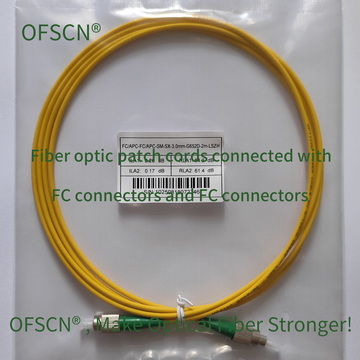
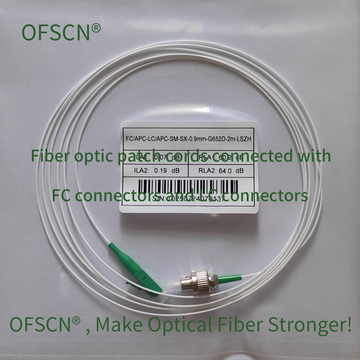
Here are examples of our patch cord products:
You can click the links to view detailed technical parameters. If you have specific technical questions, feel free to discuss further.