Increasing wall thickness improves strength, but which sensor performance metrics are sacrificed?
Increasing the wall thickness of a seamless tube for sensor packaging indeed improves mechanical strength and protection, but it generally leads to a reduction in several key sensor performance metrics.
Specifically, the primary sacrifices are:
- Reduced Sensitivity: For strain sensors, a thicker, more rigid tube will dampen the external strain, meaning the Fiber Bragg Grating (FBG) inside experiences less of the actual deformation. This reduces the sensor’s strain sensitivity. Similarly, for temperature sensors, a thicker wall can create more mechanical coupling that slightly reduces the direct thermal response of the FBG if the thermal expansion coefficients are not perfectly matched.
- Slower Response Time: For temperature sensors, a thicker tube significantly increases the thermal mass of the sensor package. This increased mass requires more time to heat up or cool down, leading to a much slower response time to changes in the ambient temperature.
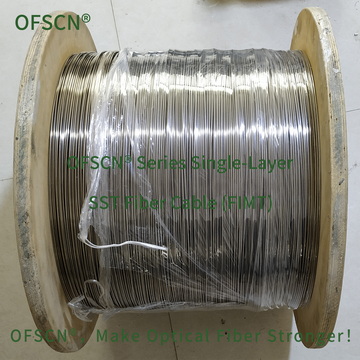
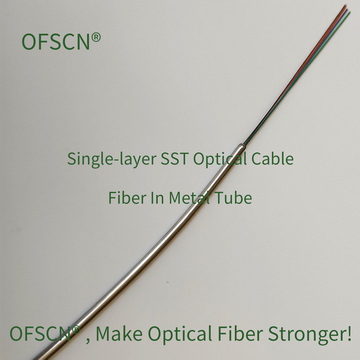
While the specific impact on FBG sensor elements within various packaging isn’t detailed for all wall thicknesses, OFSCN® offers a range of robust seamless steel tube fiber cables designed for harsh environments, where the tube’s properties are critical for protection and performance.
Here are some examples of such products:
OFSCN® 85°C Seamless Steel Tube Fiber Cable
OFSCN® 200°C Seamless Steel Tube Fiber Cable
OFSCN® 650/700°C Seamless Steel Tube Fiber Cable
Product images:
1 个赞