Will it cause a fire or explosion? Does it burn on its own?
In pure oxygen (oxygen-enriched) environments, fiber optic sensing and communication technologies offer a high degree of Intrinsic Safety. Optical fibers do not inherently cause fires or explosions in pure oxygen environments, and their glass body is completely non-combustible due to its physical and chemical properties.
I. Will it cause fire or explosion? (Explosion-proof and Intrinsically Safe due to no electricity)
Conclusion: Conventional fiber optic sensing systems will not cause fire or explosion.
- No electricity transmission, eliminating electric sparks:
- Traditional electrical sensors rely on wires to transmit current. In oxygen-enriched environments, short circuits, broken wires, electrostatic discharge, or poor connections can easily generate electric sparks or arcs, leading to violent explosions.
- Optical fibers transmit optical signals (photons) instead of electrical signals. Optical fibers themselves are insulating media, with no current, no electrostatic accumulation, and no generation of electric sparks, fundamentally eliminating electrical ignition sources.
- Ultra-low optical power injection:
- In Fiber Bragg Grating (FBG) sensing and Distributed Temperature/Strain Monitoring (DTS/OFDR), the optical power injected into the fiber by the interrogator is typically only in the milliwatt (\text{mW}) or microwatt (\mu\text{W}) range. Even if the optical fiber breaks or leaks light, the energy carried is extremely low, insufficient to generate heat that would reach the ignition point of surrounding materials.
II. Can optical fibers themselves burn? (Material Physics/Chemistry Characteristics)
Optical fibers are composed of different materials from the inside out. Their fire resistance and combustion characteristics are as follows:
- Core and Cladding (Silicon Dioxide \text{SiO}_2) — Absolutely Non-combustible:
- The core optical structure of optical fibers is high-purity quartz glass (\text{SiO}_2).
- Silicon dioxide is an inorganic non-metallic oxide in its highest oxidation state, possessing extremely stable chemical properties. It cannot be further oxidized in a 100\% pure oxygen environment, is completely non-combustible, and does not support combustion. Its melting point is above 1600^\circ\text{C}.
- Optical Fiber Coating (Polymer Material) — Depends on Selection:
- Conventional Polymer Coatings (e.g., Acrylate, Polyimide): These are organic polymer materials. Although materials like polyimide have extremely high temperature resistance and flame retardancy, in oxygen-enriched environments and under extreme external open flames/high temperatures, organic materials may still undergo slow thermo-oxidative aging.
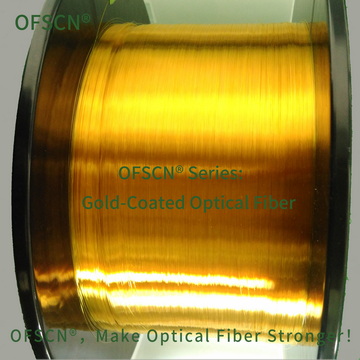
- Metal-Coated Optical Fibers (e.g., Gold-plated Fibers): The outer layer is a pure metal coating (gold, copper, etc.), containing no organic polymer materials, and does not burn in pure oxygen or extreme high-temperature environments.
III. Engineering Solutions for Pure Oxygen/Oxygen-Enriched Environments
To ensure absolute physical isolation and safety protection in pure oxygen or extreme industrial oxygen-enriched environments, seamless steel pipe encapsulated fiber optic sensors or all-inorganic metal-coated optical fibers are typically recommended:
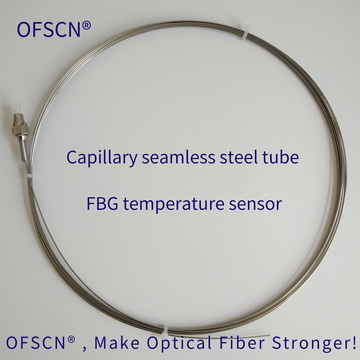
1. Seamless Steel Pipe Encapsulated Fiber Bragg Grating Sensors
These sensors utilize seamless steel pipes made of 304 or 316L stainless steel for tight encapsulation. The outer casing is fully metalized for isolation, preventing external oxygen from contacting internal organic media, and offering resistance to high pressure, corrosion, and flame.
- Product Example: OFSCN® 300°C Fiber Bragg Grating Temperature Sensor

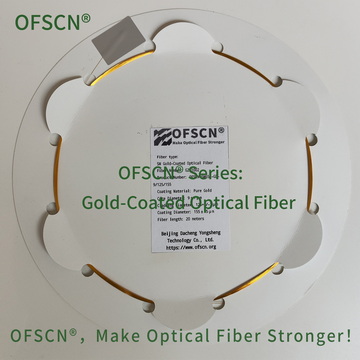
2. All-Inorganic Metal-Coated Optical Fiber (Gold-plated Fiber)
For special oxygen-enriched/high-temperature measurement applications where no polymer organic coatings are allowed, special optical fibers with gold plating on the outer layer can be used. They offer a temperature range from -270^\circ\text{C} to 700^\circ\text{C}, achieving all-inorganic non-combustible properties.
- Product Example: OFSCN® Gold-coated Optical Fiber

3. Seamless Steel Tube Armored Fiber Optic Cable
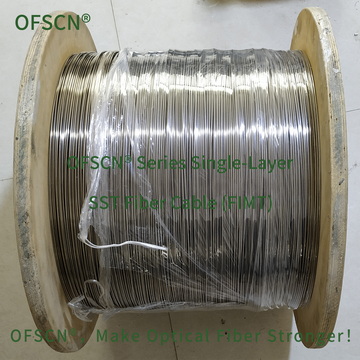
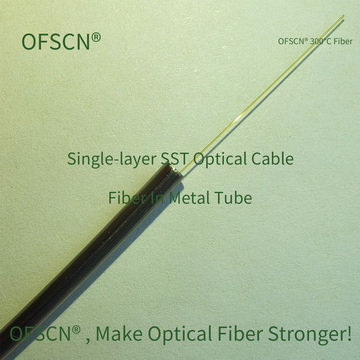
This cable utilizes seamless steel pipes (316L or 304 stainless steel) for structural protection and can be used as an explosion-proof intrinsically safe cable for long-distance communication or distributed fiber optic sensing (DTS/OFDR).
- Product Example: OFSCN® 300°C Seamless Steel Tube Fiber Cable