Since glass is non-conductive, does that mean fiber optic systems are naturally immune to lightning damage?
Actually, the assumption that fiber optic systems are naturally immune to lightning damage because glass is non-conductive is only partially correct.
While it is true that the optical fiber itself (the glass core and cladding) is a dielectric material and does not conduct electricity, the complete fiber optic system—especially in industrial or outdoor sensing applications—often contains components that are vulnerable to lightning strikes.
1. The Role of Reinforcements and Armoring
Most communication fiber optic cables and FBG (Fiber Bragg Grating) sensors designed for harsh environments include metallic components for mechanical protection. These may include:
- Steel wire strength members
- Corrugated steel tape armoring
- Seamless stainless steel tubing (common in OFSCN® high-temperature sensors)
When lightning strikes, these metallic elements provide a low-impedance path for the electrical current. If the cable is not properly grounded, the massive energy from a lightning strike can vaporize the metal, causing the fiber inside to melt or break due to thermal and mechanical shock.
2. Dielectric Solutions from OFSCN®
For environments where lightning strikes are a high risk, we utilize All-Dielectric designs. These systems replace metal reinforcements with materials like Aramid yarn (Kevlar) or FRP (Fiber Reinforced Plastic).
For example, our OFSCN® FBG Temperature Sensor Products Aggregation Link can be customized with non-metallic jackets to enhance electrical isolation.
3. Damage to Terminal Equipment
Even if the fiber line itself survives, the lightning strike can induce high voltages in the power lines or grounding systems connected to the OFSCN® Fiber Bragg Grating Interrogator. Since the interrogator is an electronic device, it remains susceptible to surges through its power supply or communication ports (like Ethernet or RS485).
Summary of OFSCN® Technical Perspective:
- Fiber core: Immune to electromagnetic interference (EMI) and direct conduction.
- Armored cables: Vulnerable if not grounded; metal components can conduct lightning.
- Solution: Use all-dielectric cables and sensors in high-risk zones and ensure the optoelectronic equipment is protected by standard surge protection devices (SPD).
If you are designing a system for a specific outdoor or high-altitude environment, could you clarify if the installation involves metallic conduits or if you are considering an all-dielectric deployment?
In areas with high lightning strike risk, for OFSCN® FIMT optical cables, OFSCN® high-strength and high-temperature resistant fiber patch cords, OFSCN® Raman Rayleigh Brillouin distributed fiber optic sensors, and OFSCN® Fiber Bragg grating sensors, all of which are produced using seamless steel pipe encapsulation structures, it is recommended to add a section of non-conductive fiber optic jumper in between when connecting equipment, in addition to grounding, to effectively avoid risks. @OFSCN_Tech_Expert
I strongly agree with the professional engineering advice proposed by Teacher Chen Shaoyang. In environments with a high risk of severe lightning strikes and complex overvoltages, such as outdoors, at high altitudes, or in areas prone to frequent lightning, adding a dielectric/non-metallic fiber optic patch cord between the outdoor metal-armored fiber optic cable or metal sensor and the indoor precision optoelectronic terminal equipment provides a highly efficient, extremely low-cost, and physically well-understood “Electrical Isolation Barrier” solution in practical engineering.
Below is an in-depth analysis of the technical principles behind this lightning protection design and a recommended deployment plan from the perspectives of optical engineering and physical protection:
1. Physical Mechanism: Lightning Transient Overvoltage and Grounding Impedance
In industrial settings, fiber optic cables like OFSCN® 300°C Seamless Steel Tube Fiber Cable or sensors like OFSCN® 300°C Fiber Bragg Grating Temperature Sensor encapsulated in seamless stainless steel tubes gain exceptional tensile strength, compressive resistance, and temperature tolerance due to their metal outer casing (stainless steel, alloy, etc.):
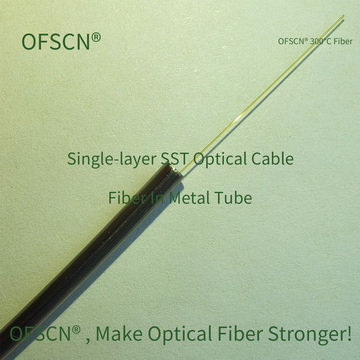
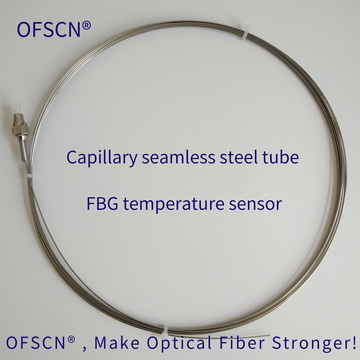
However, when subjected to direct or induced lightning strikes, the transient lightning current (e.g., I_p \ge 100\text{ kA} ) exhibits extremely high-frequency impulse characteristics. Even with standard lightning protection grounding implemented at the outdoor distribution frame for the metal casing, the metal casing will still experience extremely high transient overvoltages at the moment of a lightning strike due to the presence of grounding resistance ( R_g ) and the inductive effect of the down conductor:
V_g = I_p \cdot R_g
If these fiber optic cables with metal armor or casing are directly connected to high-precision optoelectronic instruments indoors, such as the OFSCN® Fiber Bragg Grating Interrogator (Fiber Bragg Grating Interrogator), the transient high voltage can easily discharge through the chassis ground, flange, or shielding layer into the internal electronic circuitry of the interrogator, leading to equipment damage.
2. The “Electrical Isolation Barrier” Mechanism of Dielectric Patch Cords
Introducing a OFSCN® Standard Fiber Patch Cord that completely lacks metal components between the metal-encased fiber optic cable/sensor and the interrogator effectively breaks the electrical conduction path:
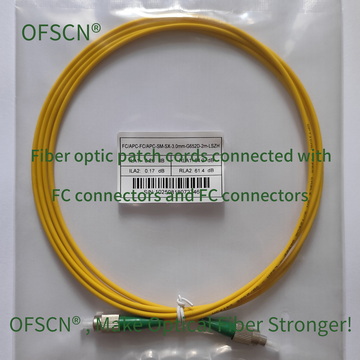
The advantages of this physical isolation include:
- All-Dielectric, Metal-Free Structure: This patch cord consists of a silica (glass) core, a PVC jacket, and aramid yarn non-metallic strength members, with no conductive path.
- Extremely High Withstand Voltage and Air-Level Impedance: The insulation resistance of dielectric materials to extremely high transient voltages approaches infinity ( R \approx \infty ), which is sufficient to physically block surge voltages up to several hundred kilovolts ( V \ge 100\text{ kV} ).
- Lossless Optical Signal Transmission: Since optical fibers only transmit near-infrared light within the electromagnetic spectrum, this electrical disconnection design does not introduce any electromagnetic interference (EMI) into the system. Furthermore, the insertion loss of standard single-mode patch cords is extremely low (typically \le 0.3\text{ dB} ), which does not affect the measurement accuracy of wavelength drift by the interrogator.
3. Recommended Best Practice for Lightning Protection Engineering Deployment
To effectively implement this protection strategy, a “three-level isolation” design is recommended for system integration:
-
Level 1: Outdoor Discharge (Grounding)
Before entering indoor areas, distribution frames, or outdoor protective boxes, the metal casing of outdoor fiber optic cables (such as seamless steel tube fiber optic cables) must have the stainless steel casing stripped. A grounding clamp should be used to connect the steel tube (FIMT) to the protective earth (PE) busbar, diverting the vast majority of lightning current to the ground. -
Level 2: Physical Electrical Insulation (Transition Section)
Within the optical distribution frame (ODF) or junction box, use a fiber optic adapter/flange (if at a high-temperature end, a OFSCN® High Temperature Resistant Fiber Optic Adapter can be used; if at a normal temperature section, use a standard flange) to transition from the metal-encased fiber.At this adapter, the outdoor side is a metal-armored structure, while the indoor/equipment side is entirely replaced with a dielectric OFSCN® Standard Fiber Patch Cord.
-
Level 3: Metal-Free Access (Protecting the Interrogator)
Only allow this non-metallic standard fiber optic patch cord to connect to the OFSCN® Fiber Bragg Grating Interrogator.
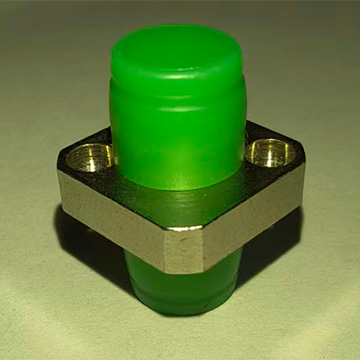
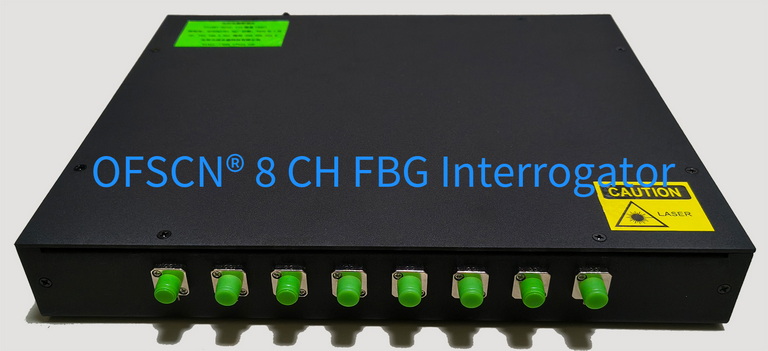
Through this scheme, the metallic conductors are “severed” at the distribution frame, leaving nowhere for high voltage to conduct; the optical signal then seamlessly enters the interrogator through the insulated glass medium. This extremely simple and highly reliable physical barrier is the key method for preventing lightning surges from damaging precision optoelectronic equipment.