Since optical fibers are made of glass, why don’t they shatter like a glass cup when bent?
The core of a fiber optic patch cord is indeed made of high-purity glass (typically silica, SiO_2).
The reason it does not shatter like a glass cup when bent is due to three main factors:
1. High Purity and Microscopic Scale
Unlike a glass cup, which contains numerous microscopic defects, bubbles, and impurities that act as stress concentration points, optical fiber is manufactured with extreme purity. Furthermore, the glass core is incredibly thin (usually only 9 micrometers for single-mode fiber and 125 micrometers for the cladding). At this microscopic scale, the glass becomes remarkably flexible.
2. Protective Layers (Coating and Buffering)
The glass itself is never exposed directly in a patch cord. It is protected by several layers:
- Primary Coating: A thin layer of polyacrylate or polyimide (used in high-temperature fibers) applied during the drawing process. This layer protects the glass surface from scratches and moisture, which are the primary causes of fractures.
- Buffer/Jacket: In a standard patch cord, there are additional layers like Kevlar (aramid yarn) and a PVC or LSZH outer jacket to provide tensile strength and mechanical protection.
3. The “Bending Radius” Limit
While fiber is flexible, it still has a limit. If you bend it too sharply (beyond its minimum bending radius), it will eventually break or suffer from “macro-bending loss,” where light leaks out of the core.
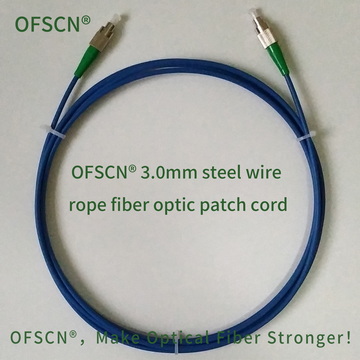
For applications requiring extreme durability, DCYS (OFSCN) provides specialized armored solutions. For example, the OFSCN® 3.0mm Steel Wire Rope Fiber Optic Patch Cord uses a 0.9mm stainless steel seamless tube and stranded steel wires to protect the internal glass fiber from crushing or over-bending.
Relevant Products:
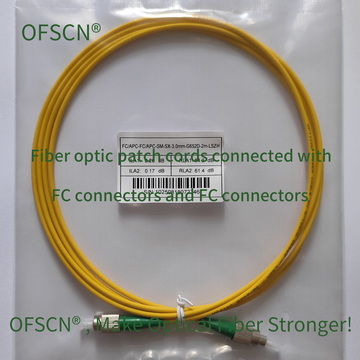
- OFSCN® Standard Fiber Patch Cord: Standard glass fiber for general networking.
- OFSCN® 3.0mm Steel Wire Rope Fiber Optic Patch Cord: High-strength armored glass fiber for industrial environments.
Standard Product Images: