Is the relationship between wavelength shift and temperature/strain perfectly linear?
The relationship between wavelength shift and physical parameters for FBG sensors is generally highly linear for strain, but typically non-linear for temperature.
For strain sensors, the relationship between wavelength shift and applied strain is predominantly linear. Our OFSCN® Alloy Tube Packaged Fiber Bragg Grating strain sensor and OFSCN® Polymer-encapsulated Fiber Bragg Grating Strain Sensor utilize this linear characteristic, where the strain-wavelength calibration formula is generally a monomial.
Here’s an example image of one of our strain sensors:

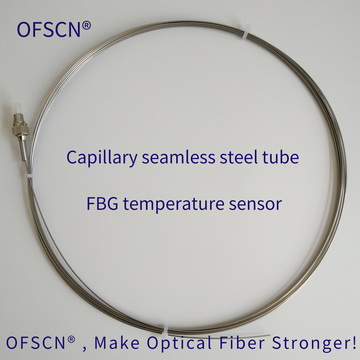
For temperature sensors, the relationship between wavelength shift and temperature is often described by a binomial (second-order) polynomial, meaning it is not perfectly linear. While it can be approximated as linear over small temperature ranges, a more accurate representation requires a higher-order fit for broader ranges. Our OFSCN® 500°C Fiber Bragg Grating Temperature Sensor, for instance, typically uses a binomial temperature-wavelength calibration formula.
Here’s an example image of one of our temperature sensors:
You can find more detailed technical parameters on our respective product pages: