How to quickly identify the jacket material of a fiber optic cable by touch and flame?
In fiber optic engineering and patch cord selection, PVC (Polyvinyl Chloride) and LSZH (Low Smoke Zero Halogen) are the two most common types of outer jacket materials. These two materials can be quickly and accurately identified through tactile feel (touch/appearance) and flame test:
I. Tactile and Appearance Identification Method (Touch Method)
| Identification Dimension | PVC Jacket | LSZH Jacket |
|---|---|---|
| Surface Feel | Smooth, oily, flexible: Due to the presence of plasticizers, it has a relatively fine texture, with a slight plastic-like, viscous feel. | Dry, matte, relatively stiff: Due to the addition of a large amount of inorganic flame retardant fillers, the feel is drier, with a distinct powdery or slightly matte texture. |
| Bending and Flexibility | High flexibility, good resilience when repeatedly bent, jacket is less prone to turning white. | The texture is relatively stiff and brittle, with slightly less flexibility than PVC when bent. |
| Surface Gloss | The surface is mostly bright or semi-glossy. | The surface is mostly matte (dull/non-glossy). |
| Fingernail Scratch/Folding Test | When scratched forcefully with a fingernail or folded, the surface usually shows no obvious white marks. | When scratched forcefully with a fingernail or folded tightly, the surface easily shows whitening or light-colored powdery marks. |
II. Combustion Characteristics Identification Method (Flame Test)
The flame test is the most reliable method for identifying the two on-site (test a small piece of discarded patch cord jacket):
| Identification Feature | PVC Jacket | LSZH Jacket |
|---|---|---|
| Flame Characteristics | The base of the flame often has a greenish-yellow hue/green edge (characteristic reaction of chlorine). | The flame is a standard yellow. |
| Smoke State | Produces dense, acrid, billowing black smoke. | Produces only a very small amount of thin white/light gray smoke (almost no black smoke). |
| Odor Characteristics | Releases an extremely pungent, acrid, respiratory-irritating acidic mist (mainly \text{HCl} hydrogen chloride acidic gas released upon decomposition). | The odor is very faint, with no pungent acidity, accompanied by a slight burning smell like heated paraffin or inorganic substances. |
| Burning State | Burning is accompanied by softening, bubbling, expansion, or molten dripping of the material. | Good flame retardancy and self-extinguishing properties; often extinguishes quickly after removal from flame; does not melt or drip, surfaces directly carbonize. |
| Burning Residue | The residue is black, coked, hard lumps. | The residue is off-white or light gray powder/ash (mainly metal oxides after decomposition of aluminum hydroxide or magnesium hydroxide). |
III. Summary Recommendations
- Standard indoor general environments: PVC offers good mechanical flexibility and fatigue resistance, with a higher cost-performance ratio.
- High-density data centers/enclosed spaces/locations with high fire rating requirements: LSZH jackets must be used to ensure that no large amounts of toxic smoke and corrosive acid mist are produced in the event of a fire.
- Harsh industrial environments (high temperature, high stress): If higher temperature resistance or greater mechanical tensile/compressive impact is required, conventional polymer jackets (PVC/LSZH) are usually limited. It is recommended to use high-temperature resistant fiber optic patch cords with stainless steel micro-armor protection.
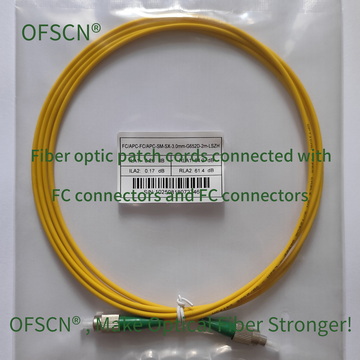
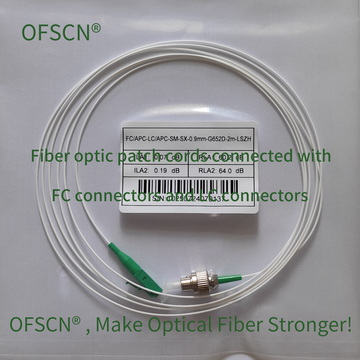
Beijing Dacheng Yongsheng Technology Co., Ltd. (OFSCN®) offers the following standard indoor fiber optic patch cord products:
Product Name: OFSCN® Standard Fiber Patch Cord | Official Link
Standard Image Links
Main Parameter Indicators
- Composed of fiber optic connectors (FC, ST, LC, SC; PC or APC), PVC jacket, aramid fiber, and optical fiber;
- Default diameter 3\text{mm} , customizable diameters 2\text{mm} , 0.9\text{mm} ;
- Default fiber optic connector type is FC/APC, other types can be customized;
- Default length is 2\text{m} , other lengths can be customized (from 10\text{cm} to several hundred meters);
- Default fiber type is OFSCN® G.652D Optical Fiber;
- Operating temperature range: -20℃ \sim 50℃ .