On industrial sites, is thread locking really more reliable than plastic clips?
In industrial settings and harsh environments, the reliability of metal threaded connectors (like FC connectors) is indeed far superior to plastic latches (like SC, LC connectors). This is not subjective experience, but rather determined by the mechanical physical structure, material mechanical properties, and the extremely high precision physical characteristics of fiber optic sensing systems.
This can be specifically analyzed from the following core technical dimensions:
1. Mechanical Locking Strength and Anti-Detachment Capability (Axial Endurance)
- FC Connectors: Utilize a metal threaded coupling mechanism. When the plug is fully screwed into the adapter (flange), a strong mechanical interlock is formed by the rigid friction and physical positioning of the metal threads. In industrial settings, fiber optic cables are often subjected to dragging and strong pulling forces. The metal threaded mechanism of FC connectors can withstand extremely high axial tensile forces without physical detachment.
- SC / LC Connectors: Employ plastic latches (Snap-on Latch/Push-pull) or pin-and-latch locking. This design was initially developed for high-density deployments in telecom rooms and data centers, facilitating quick insertion and removal. However, plastic latches rely on the elastic deformation of the material, offering extremely low resistance to tensile forces. Once the fiber optic cable is subjected to external pulling forces, the latch is prone to slipping or breaking, leading to a direct interruption of the physical connection.
2. Anti-Micro-Vibration and Optical End-Face Stability (Alignment Stability)
Industrial sites (such as around motors, pumps, fans, or heavy machinery) are generally subject to continuous micro-vibrations.
- Fatalness of Micron-Level Displacement: In single-mode fiber systems, the Mode Field Diameter (MFD) of the fiber is typically only about 9\ \mu\text{m} to 10\ \mu\text{m}. In fiber optic sensing (such as Fiber Bragg Grating sensing FBG, phase-sensitive distributed sensing \Phi\text{-OTDR}, etc.), extremely subtle axial displacements of the end-face (even less than 1\ \mu\text{m}) can cause severe signal fluctuations, polarization state variations, and Insertion Loss (IL) fluctuations.
- FC Performance: The threaded tightening of FC connectors achieves “zero-gap” axial compression, locking the relative position between the plug and the adapter’s ceramic ferrule (Sleeve), thereby cutting off the influence of external mechanical vibrations on the ferrule’s end-face contact.
- SC / LC Performance: Plastic latch connectors inherently have mating tolerances and physical gaps in their structure. When operating in a continuous vibration environment, the ferrule will experience high-frequency micro-wiggling within the adapter. This wiggling manifests as random optical noise in the optical path, significantly reducing the signal-to-noise ratio and demodulation accuracy of high-sensitivity sensing systems.
3. Material Environmental Resistance: Plastic Aging vs. Metal Stability
- Limitations of Plastic Latches: The housings and locking structures of SC, LC, and other connectors are mostly made of engineering plastics (such as PBT, PEI, etc.). In industrial environments with high and low temperature cycles, UV exposure, or exposure to chemicals like acids, alkalis, oils, and greases:
- High Temperature: As the temperature rises, the elastic modulus of plastic materials rapidly decreases, the latch softens, and the locking clamp force is significantly weakened.
- Low Temperature and Aging: Under extreme cold or prolonged UV exposure, plastics undergo embrittlement, making them highly susceptible to breaking when subjected to slight vibrations or external pulling forces.
- Physical Resistance of Metal Threads: The housings and coupling nuts of FC connectors are often made of materials like nickel-plated brass or stainless steel. These materials maintain their high rigidity and high yield strength over a wide temperature range and in harsh chemical environments, and their locking function does not fail due to thermal aging or embrittlement.
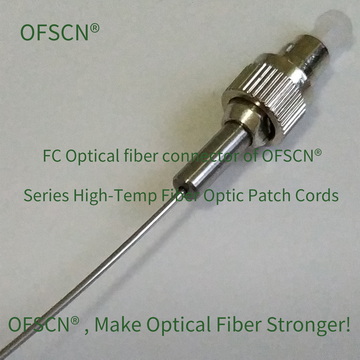
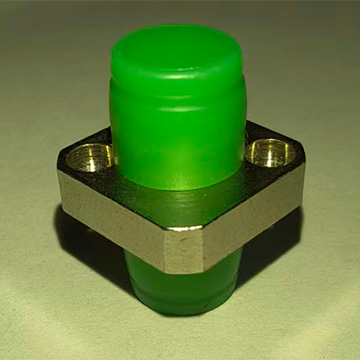
DaCheng YongSheng (OFSCN®) produces high-temperature fiber optic connector components based on the metal FC threaded structure design to meet the long-term stability requirements in harsh industrial environments:
- OFSCN® 120℃ Fiber Optic Connector
- OFSCN® 200℃ Fiber Optic Connector
- OFSCN® 300℃ Fiber Optic Connector
- OFSCN® High Temperature Resistant Fiber Optic Adapter (Can withstand industrial temperatures up to 300\ ^\circ\text{C}, providing rigid FC locking support)
4. Physical Contact Assurance and High Return Loss (Return Loss)
In precision sensing, to suppress optical reflection noise, APC (Angled Physical Contact) with an 8^\circ angled end-face is usually recommended.
- FC/APC: Through the axial clamping force of the threads, it ensures close physical contact between the end-faces of the two ceramic ferrules. The Return Loss can be stably maintained at an extremely high level of \ge 60\ \text{dB}.
- If snap-on SC or LC connectors are used, once the latch slightly springs back (axial loosening) due to external force or aging, a small air gap will form between the end-faces. This will cause the Return Loss to drop sharply to approximately \sim 14\ \text{dB}, leading to strong optical reflections back into the laser and demodulation end. This often causes signal blockage or severe distortion in high-speed coherent sensing or FBG demodulation systems.
Summary
In temperature and humidity-controlled IDC data centers, plastic latch connectors (SC, LC) are the preferred choice due to their high density and rapid deployment advantages; however, in industrial sites with strong vibrations, high pulling forces, extreme temperature variations, and chemical corrosion, as well as in fiber optic sensing applications that require absolute constancy of optical physical states, the FC metal threaded locking mechanism offers irreplaceable rigid structural advantages and is the core engineering choice for ensuring high reliability of the sensing physical link.