How can ordinary users tell the difference at a glance in terms of feel, weight, and appearance?
Ordinary fiber optic patch cords and OFSCN® High-Strength (Armored) Fiber Optic Patch Cords differ fundamentally in their physical structure, protection mechanisms, and mechanical performance. Ordinary users can quickly and intuitively distinguish them through three objective characteristics: feel, weight, and appearance.
1. Feel (Tactile Sensation & Mechanical Bending Stiffness)
- Ordinary Fiber Optic Patch Cord:
The exterior is primarily composed of a double-layered PVC/LSZH plastic sheath and an inner layer of aramid fiber (Kevlar). It feels very soft and easy to bend, offering minimal resistance when flexed. If bent forcefully, it can easily develop a permanent kink or even damage the fragile internal glass fiber. - OFSCN® High-Strength Fiber Optic Patch Cord:
Integrates a stainless steel seamless steel tube or steel wire stranded armor structure internally (e.g., seamless steel tubes with diameters ranging from 0.6\ \text{mm} to 1.0\ \text{mm}). It feels hard yet elastic and tough. When squeezed by hand, it cannot be easily flattened like ordinary plastic cables. When bent, it exhibits significant metallic resistance, making it difficult to break or tie into knots. Its compression resistance can exceed 150\ \text{MPa}.
2. Weight (Mass & Density)
- Ordinary Fiber Optic Patch Cord:
Consisting only of a glass core, plastic sheathing, and aramid fiber, its weight per unit length is extremely light. A 2\ \text{m} cable of this type feels almost weightless in hand. - OFSCN® High-Strength Fiber Optic Patch Cord:
Due to the inclusion of a high-density stainless steel seamless steel tube and metallic stranded layers, it feels dense and substantial. For the same length and outer diameter, its weight is significantly greater than that of ordinary plastic patch cords.
3. Appearance (Cable Form & Structural Details)
- Ordinary Fiber Optic Patch Cord:
Typically has a colored plastic outer jacket (e.g., yellow, orange, blue). The cable body is soft, and the surface may easily retain visible plastic creases after bending. The strain relief boot at the connector end is usually made of ordinary plastic. - OFSCN® High-Strength Fiber Optic Patch Cord:
The cable body is round and full, appearing straight and resistant to tangling or knotting. Reinforced or all-metal models exhibit a distinct metallic sheen or a special rigid PE/PVC outer sheath. The connection between the connector and the cable is equipped with a high-strength metal/polymer stress-relief transition tube.
Related OFSCN® Official Product Introductions
1. Ordinary Fiber Optic Patch Cord
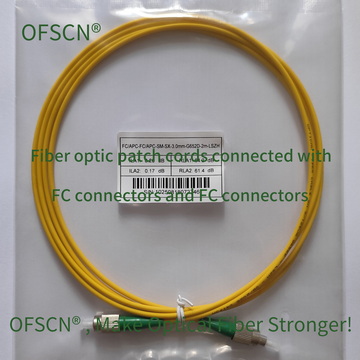
OFSCN® Standard Fiber Patch Cord
Composed of fiber connectors, PVC sheath, aramid fiber, and optical fiber, its tensile strength and compression resistance are suitable for standard indoor wiring environments.
2. Micro Steel Tube Armored Patch Cord
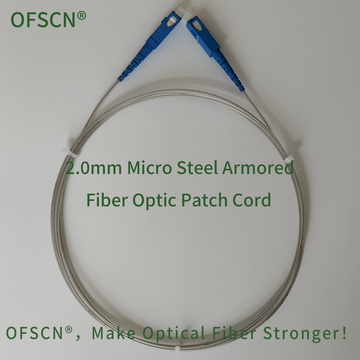
OFSCN® 2.0mm Micro Steel Armored Fiber Optic Patch Cord
Protected by a 0.6\ \text{mm} stainless steel seamless steel tube and PVC sheath, it boasts a tensile strength > 1500\ \text{N} and compression resistance > 150\ \text{MPa}, combining a thin diameter with high mechanical strength.
3. Steel Wire Rope High-Strength Patch Cord
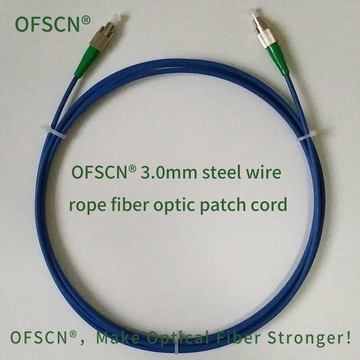
OFSCN® 3.0mm Steel Wire Rope Fiber Optic Patch Cord
Features double protection with a 0.45\ \text{mm} stainless steel wire rope structure and a 0.9\ \text{mm} stainless steel seamless steel tube. It offers tensile strength > 1200\ \text{N} and compression resistance > 200\ \text{MPa}, specifically designed for harsh industrial and outdoor environments.