What is the fundamental difference in reliability between civil communication patch cords and industrial sensor patch cords?
The essential difference in reliability between civil communication patch cords and industrial sensing patch cords stems from the differences in their design redundancy, material physicochemical properties, mechanical protection mechanisms, and operating environmental boundary conditions.
In optical engineering and sensing technology, the reliability difference between the two is mainly reflected in the following core physical and process dimensions:
I. Coating Material and Thermal Degradation Mechanism
Bare quartz fiber (silica substrate) is highly susceptible to mechanical fracture due to the expansion of microcracks in the environment, thus requiring coating for physical protection.
- Civil communication patch cords: Typically use a dual-layer acrylate coating. This material performs excellently at room temperature, but its long-term temperature resistance limit is usually only -40^\circ\text{C} to +85^\circ\text{C} . Exceeding this temperature range causes thermal aging, discoloration, embrittlement, or even vaporization and decomposition of the acrylate, leading to the fiber losing protection and rapidly succumbing to fatigue fracture.
- Industrial sensing patch cords: Often need to operate in extreme temperature zones such as industrial, geothermal, high-voltage grid, or aerospace environments. To ensure absolute reliability, special temperature-resistant coatings must be used:
- Polyimide coating: Can operate long-term in environments from -270^\circ\text{C} to +300^\circ\text{C} (even instantaneously up to +400^\circ\text{C} ), maintaining mechanical stability and tight buffer adhesion.
- Metal coating (e.g., Gold-coated): Can operate under extreme conditions of ultra-high or ultra-low temperatures from -270^\circ\text{C} to +700^\circ\text{C} , completely eliminating the risk of failure due to high-temperature degradation of organic materials.
II. Microbending Loss and Parasitic Stress Shielding
- Civil communication patch cords: Their primary function is to transmit optical power, and their design allows for a certain degree of macro- or microbending loss as long as it does not affect the overall Optical Signal-to-Noise Ratio (OSNR) and bit error rate. Their external protection is usually made of non-rigid materials such as Polyvinyl Chloride (PVC), Low Smoke Zero Halogen (LSZH), and Aramid Fiber (Kevlar), primarily resisting static and tensile loads.
- Industrial sensing patch cords: In Fiber Bragg Grating (FBG) sensing or distributed fiber sensing (DTS/OFDR/BOTDR) systems, the wavelength, phase, Rayleigh scattering, and intensity of scattered light are extremely sensitive to external physical fields (temperature, strain, vibration). If the patch cord casing is subjected to parasitic stresses unrelated to measurement (such as side pressure, shear, vibration, or uneven thermal expansion), it can cause random microbending loss within the optical fiber, leading to wavelength drift or signal-to-noise ratio degradation. Therefore, industrial sensing patch cords typically require high-rigidity encapsulation, such as seamless stainless steel tubes (SST), to provide sufficient compressive strength and structural rigidity to shield against parasitic stresses.
III. Chemical Corrosion and Hydrogen Aging Resistance
- Civil communication patch cords: Deployed indoors with controlled temperature and humidity, the chemical environment is relatively mild. The outer jacket does not possess the ability to resist strong acids and alkalis, salt spray, or grease for extended periods.
- Industrial sensing patch cords: The operating environment is often filled with moisture, corrosive media (acids, alkalis, salts), or high-pressure hydrogen.
- Chemical Corrosion: Plastic outer jackets (PVC/LSZH) are prone to hydrolysis and cracking in harsh chemical media or high-temperature steam. Contact of moisture and trace chemical media with the optical fiber accelerates the degradation of the silica glass’s stress corrosion limit.
- Hydrogen Aging: Free hydrogen molecules ( \text{H}_2 ) can easily permeate into the silica optical fiber under high temperature and pressure, reacting with \text{Si-O} bonds to form \text{OH}^- hydroxyl groups. This introduces significant characteristic absorption loss in the near-infrared sensing bands (e.g., around 1380\ \text{nm} , 1550\ \text{nm} ). High-reliability industrial sensing patch cords block hydrogen and moisture penetration through tightly sealed casings (like FIMT steel tubes) or hydrogen-resistant fibers.
OFSCN® Industrial/Sensing Patch Cord Design Examples
DaCheng YongSheng (OFSCN®) has developed a series of highly reliable industrial-grade fiber optic patch cords with all-metal armored protection, addressing the aforementioned physical limitations of industrial sites:
-
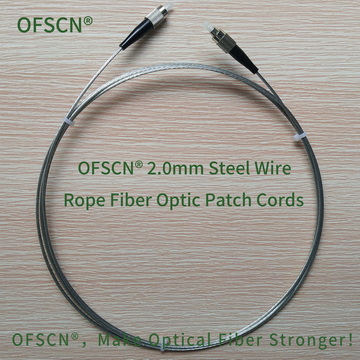
High Tensile Strength and Protection Applications: OFSCN® 2.0mm Steel Wire Rope Fiber Optic Patch Cord
This product features double-layer metal armor, consisting of an inner layer of 1.0\ \text{mm} seamless stainless steel tube and an outer layer of 0.6\ \text{mm} galvanized steel wire stranding. This all-metal stranded structure provides excellent tensile strength, shear resistance, and a physical barrier against rodent damage, suitable for sensing or communication networks with severe mechanical vibration and high tensile loads.Product Schematic:
-
Medium to High Temperature Sensing Applications: OFSCN® 300℃ Fiber Optic Patch Cord
This patch cord uses a 0.9\ \text{mm} diameter seamless stainless steel tube, encapsulating 300^\circ\text{C} polyimide single-mode fiber inside. It can operate long-term within an extremely wide temperature range of -270^\circ\text{C} to +300^\circ\text{C} , meeting industrial scenarios such as oil well logging, geothermal drilling, and temperature sensing on power busbars.Product Schematic:
-
Extreme High Temperature Sensing Applications: OFSCN® 700℃ Fiber Optic Patch Cord
Utilizing a 0.9\ \text{mm} seamless stainless steel tube and high-performance gold-plated fiber, its extreme physical temperature tolerance extends to -270^\circ\text{C} to +700^\circ\text{C} . In applications like metallurgical furnace monitoring and aerospace high-temperature airflow testing, this structure ensures that even if all polymer materials fail, the metal components continue to provide sealing and support for the optical fiber.Product Schematic: