How are these multimode fibers classified? How can they be distinguished by color?
“OM” stands for “Optical Multimode” (multimode fiber). According to the standards of the International Electrotechnical Commission (IEC) and the International Organization for Standardization (ISO), the grades of multimode fiber are mainly divided into OM1, OM2, OM3, OM4 (and the latest OM5).
These multimode fibers have clear and rigorous classification standards in terms of physical performance, transmission rate, maximum transmission distance, and outer jacket color coding.
I. Basis for Classification of Multimode Fiber Grades
The grade classification of multimode fiber essentially depends on its internal physical structure and its ability to support light sources and bandwidth:
1. Core/Cladding Diameter
- OM1: Its core diameter is 62.5\ \mu\text{m}, and the cladding diameter is 125\ \mu\text{m}. Due to the thicker core, the modal dispersion (light’s repeated reflection within the core) is larger, thus limiting its bandwidth.
- OM2, OM3, OM4: Their core diameters are all a narrower 50\ \mu\text{m}, with the same cladding diameter of 125\ \mu\text{m}. A smaller core can more effectively confine the light beam and reduce multipath dispersion of light waves.
2. Compatible Light Source & Optimization
- OM1 and OM2: These are traditional multimode fibers, primarily designed for traditional LED (Light Emitting Diode) light sources. LED light sources produce a wider emission angle and beam divergence.
- OM3 and OM4: These are “laser-optimized” multimode fibers. They employ a graded-index structure and are deeply optimized for 850\ \text{nm} VCSEL (Vertical-Cavity Surface-Emitting Laser) light sources, enabling support for extremely high laser modulation frequencies.
3. Effective Modal Bandwidth (EMB @ 850nm)
- OM1: EMB \ge 200\ \text{MHz}\cdot\text{km}
- OM2: EMB \ge 500\ \text{MHz}\cdot\text{km}
- OM3: EMB \ge 2000\ \text{MHz}\cdot\text{km}
- OM4: EMB \ge 4700\ \text{MHz}\cdot\text{km}
4. Transmission Performance (Rate & Max Distance @ 850nm)
- OM1: Mainly used for 100M or 1G Ethernet. At 1\ \text{Gbps} rate, the maximum distance is 275\ \text{m}; at 10\ \text{Gbps} rate, the maximum distance is only 33\ \text{m}.
- OM2: At 1\ \text{Gbps} rate, the maximum distance can reach 550\ \text{m}; at 10\ \text{Gbps} rate, the maximum distance is 82\ \text{m}.
- OM3: Mainly used in 10G or higher-speed data centers. At 10\ \text{Gbps} rate, the maximum distance is 300\ \text{m}; at 40\ \text{Gbps} / 100\ \text{Gbps} rates, the maximum distance is 100\ \text{m}.
- OM4: Specifically designed for ultra-high-speed, high-density computing. At 10\ \text{Gbps} rate, the maximum distance can reach 550\ \text{m}; at 40\ \text{Gbps} / 100\ \text{Gbps} rates, the maximum distance is 150\ \text{m}.
II. Color Differentiation (According to TIA-598C / ISO/IEC 11801 Standards)
To visually identify and prevent incorrect connections in engineering, non-military or special application multimode fibers have standard industry specifications for the color of their outer jackets on cables and patch cords:
- OM1: The outer jacket is by default Orange.
- OM2: The outer jacket is also by default Orange. (To distinguish between OM1 and OM2, one usually needs to check the printed text on the fiber jacket, e.g., 62.5/125 vs. 50/125).
- OM3: The outer jacket is by default Aqua.
- OM4: The outer jacket is by default Aqua. However, in some national and manufacturer specifications (e.g., European standards), to strictly differentiate OM4 from OM3, OM4 may use Erika Violet.
III. Engineering Applications of Multimode Fiber in Special Environments
In ordinary communication equipment rooms, multimode fibers use standard plastic materials (such as PVC / LSZH) for their jackets with the aforementioned colors. However, in special industrial environments with high temperatures, high pressure, corrosion, or space constraints, as well as in distributed fiber optic sensing applications, Beijing Dacheng Yongsheng Technology Co., Ltd. (OFSCN®) offers special protective fiber optic cables and fiber products that can accommodate or be customized for multimode fibers:
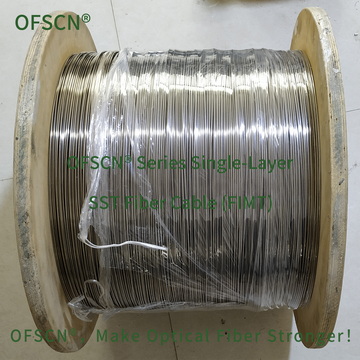
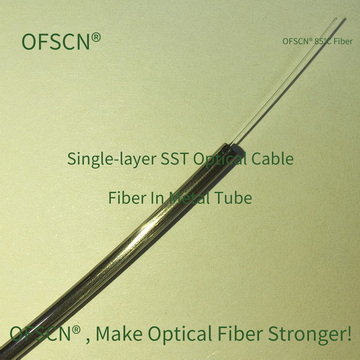
1. OFSCN® 85°C Seamless Steel Tube Fiber Cable
This seamless steel tube fiber optic cable is designed for harsh communication and distributed fiber optic sensing. It can accommodate single-mode or multimode fibers (including OM2, OM3, OM4, etc.) internally based on project requirements. The stainless steel outer protective tube provides extremely strong resistance to being stepped on, gnawed by rodents, and side pressure.
2. OFSCN® 120℃ MM High-temperature Optical Fiber
This product is a multimode high-temperature optical fiber developed for medium to high-temperature industrial operating conditions. The core diameter is 50\ \mu\text{m} (same as OM2/OM3/OM4), the coating uses high-temperature resistant polyacrylate (outer diameter is 255\ \mu\text{m}), and the operating temperature range is between -50^\circ\text{C} and 120^\circ\text{C}.


3. OFSCN® 200℃ Polyimide Optical Fiber
High-flexibility polyimide-coated optical fiber designed for high-temperature environments, supporting customized multimode fibers (optional 50\ \mu\text{m} or 62.5\ \mu\text{m} core diameter), capable of long-term stable signal transmission within the harsh temperature range of -60^\circ\text{C} to 200^\circ\text{C}.

4. OFSCN® 300℃ MM Polyimide Optical Fiber
Polyimide-coated multimode fiber designed for operation in extreme high and low temperatures ( -200^\circ\text{C} to 350^\circ\text{C} ), available with 50\ \mu\text{m} or 62.5\ \mu\text{m} core specifications, significantly extending the boundaries of multimode transmission in harsh industrial operating conditions.

