What errors occur if the reflected signal is too strong? How can this be adjusted via hardware or software?
When the reflected signal in an FBG interrogator is too strong, it can lead to optical power saturation. This occurs when the detector or analog-to-digital converter in the interrogator receives more optical power than it can accurately process.
The primary errors that occur due to optical power saturation include:
- Wavelength Inaccuracy: The peak wavelength detection algorithm relies on a clear, undistorted FBG spectrum. Saturation can flatten or distort the top of the spectrum, making it difficult for the interrogator to accurately identify the true Bragg wavelength, leading to measurement errors.
- Reduced Dynamic Range: The ability of the interrogator to measure both strong and weak signals simultaneously is compromised. If strong signals saturate the detector, weaker signals might be completely missed or measured with poor accuracy.
- Signal Distortion: The shape of the reflected FBG spectrum can become distorted, making it challenging to extract reliable data, especially in applications requiring precise spectral analysis.
- False Readings/Errors: In severe cases, the interrogator might report out-of-range values or generate error flags, as it cannot properly interpret the saturated signal.
Adjustments to mitigate optical power saturation can be made via hardware or software:
Hardware Adjustments:
- Reduce Input Optical Power: This is often the most direct method. If the FBG system uses an external light source, its power can be attenuated.
- Adjust Interrogator Input Gain: Some interrogators have adjustable optical gain settings. Reducing the gain can prevent saturation.
- Fiber Optic Attenuators: Placing a fixed or variable fiber optic attenuator in the optical path before the interrogator can reduce the signal strength.
- FBG Reflectivity: For new installations, specifying FBGs with lower reflectivity can help prevent saturation, especially if multiple FBGs are cascaded.
Software Adjustments:
- Gain Control (Digital): While less common for direct optical power saturation, some interrogator software may have digital gain settings that can be adjusted to scale down the signal after detection, though this doesn’t prevent saturation at the hardware level if the detector is already overloaded. It can help if the saturation occurs in the ADC stage.
- Thresholding/Clipping Detection: Advanced software might detect and flag saturated signals, although this doesn’t fix the underlying problem but rather alerts the user to potential inaccuracies.
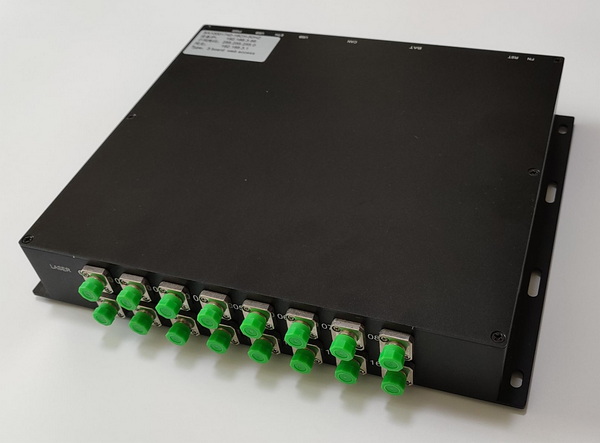
For detailed information on the technical parameters and capabilities of our interrogators, you can refer to the OFSCN® Fiber Bragg Grating Interrogator.
Here is a standard image of our interrogator:
1 个赞