The core is glass and the jacket is plastic, what is the special purpose of this combination? OFSCN®
PCS (Plastic-Clad Silica) fiber is a large-core multimode fiber featuring a high-purity silica glass (quartz) core and a polymer (plastic, such as silicone or fluoropolymer) with a lower refractive index as the cladding.
This “glass core, plastic cladding” design isn’t a compromise for cost reduction but offers a range of highly specialized applications and advantages in optical engineering and physical properties:
1. Extremely High Light Coupling Efficiency: High Numerical Aperture (NA)
The refractive index of pure quartz glass core is approximately 1.45. Traditional all-glass fibers, due to doping process limitations, have a cladding refractive index very close to the core, resulting in a generally small Numerical Aperture (NA) (around 0.1 to 0.2).
PCS fiber uses fluoropolymers or silicones with very low refractive indices (e.g., 1.35 to 1.40) for the cladding. The significant refractive index difference (\Delta n) between the core and cladding allows PCS fiber to achieve a very high numerical aperture (typically NA \ge 0.37, even up to 0.5).
- Special Applications: This greatly widens the fiber’s acceptance angle, enabling extremely high light coupling efficiency when facing highly divergent light sources like semiconductor lasers (LDs) and light-emitting diodes (LEDs). Consequently, it is often used for high-power laser energy transmission (e.g., medical laser scalpels, industrial laser welding) and collecting weak low-end signals in spectral analysis.
2. Combines Large Core Diameter with Excellent Bend Flexibility
For high-power energy transmission or physical detection in specific wavelength bands, optical fibers typically require a thicker core (e.g., 200\ \mu\text{m}, 400\ \mu\text{m}, 600\ \mu\text{m}, or even larger).
- Drawbacks of All-Glass Large-Core Fibers: If traditional all-quartz (quartz core + quartz cladding) structures are used, when the fiber diameter increases, the outer quartz cladding is highly susceptible to catastrophic brittle fracture due to micro-crack propagation during large-angle bending.
- Advantages of PCS: The plastic cladding is elastic and provides excellent stress buffering and mechanical protection when the fiber is bent. This allows large-core PCS fibers to withstand relatively small bending radii, offering extremely high resistance to mechanical shock and flexibility. They are suitable for use in confined, high-vibration industrial or in-vehicle environments.
3. Convenient, Low-Cost Field End-Face Preparation (Crimp & Cleave)
Connecting and splicing all-glass fibers typically requires expensive fusion splicers or precise multi-stage grinding and polishing after epoxy curing.
- Special Applications: Certain types of PCS fibers (especially hard polymer clad fiber - HCS) support the “Crimp and Cleave” process. Field technicians can strip the coating with simple wire strippers, insert the fiber core into a specific connector, crimp it, and then cleave the end face flat for use. No fusion splicing or polishing is required. This offers unparalleled field maintenance convenience in scenarios requiring rapid deployment, such as industrial fieldbuses, wind power generation, and substation control.
Technical Limitations of PCS Fiber
Despite its obvious advantages, PCS fiber cannot replace all-silica (All-Silica) fibers in some demanding physical conditions:
- Low Temperature Limit: The thermal stability and glass transition temperature of plastic cladding are far lower than quartz. At high temperatures, the plastic cladding can age, shrink, or detach, losing its waveguide function.
- Higher Optical Loss: Due to stronger photon absorption by polymers than by quartz, PCS fibers typically have attenuation in the range of several decibels per kilometer (dB/km). Therefore, they cannot be used for long-haul backbone optical communication over tens of kilometers, usually being limited to medium-short distance transmission from a few meters to two kilometers.
Special Optical Fiber Material Selection Guidance
Within Beijing Dacheng Yongsheng Technology Co., Ltd.'s (OFSCN®) special fiber product line, to address more extreme physical conditions (such as operating temperature ranges from -200\text{℃} to 350\text{℃}, or stringent requirements for broad spectrum and high laser damage thresholds), we primarily use all-silica (AS) large-core fibers with high-temperature resistant metal or polymer coatings, rather than plastic cladding.
If you are looking for a high-performance large-core transmission solution that is high-temperature resistant and covers a broad spectrum, you can refer to related products from Beijing Dacheng Yongsheng Technology Co., Ltd. (OFSCN®):
OFSCN® Polyimide Large-Core Optical Fiber
This series of products uses standard inorganic silica core and silica cladding (all-silica structure), with a high-temperature resistant polyimide coating on the outside. It can operate continuously in environments from -200\text{℃} to 350\text{℃} (short-term up to 400\text{℃}), with a usable wavelength range from 200\text{nm} to 2400\text{nm}, and possesses extremely high thermal stability and optical damage threshold.
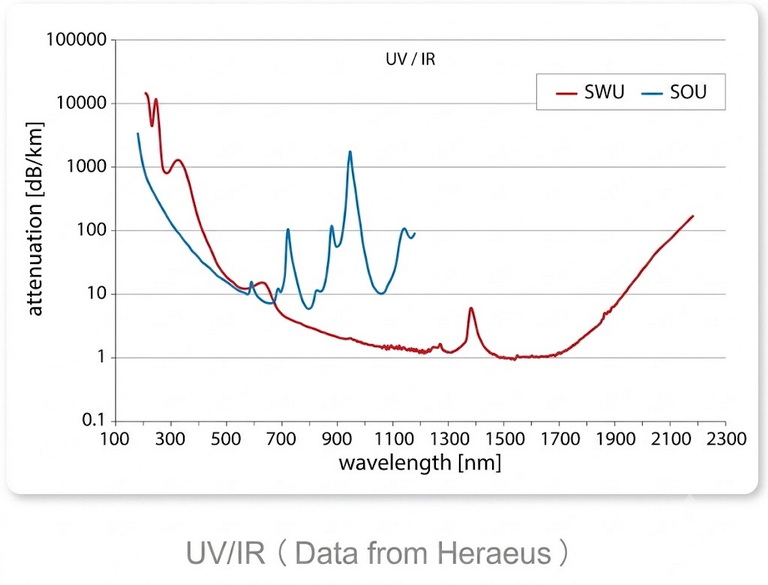
It should be clarified that plastic-clad fiber (PCS) is not part of Beijing Dacheng Yongsheng Technology Co., Ltd.'s (OFSCN®) standard product sequence. However, in basic optical engineering and low-cost, short-distance, high-energy transmission applications, it represents a highly ingenious physical material combination design.