Does the change in the polarization direction of light affect the spectral splitting ratio?
Yes, the polarization direction of light does affect the splitting ratio. The physical essence and engineering manifestation of this influence primarily originate from a key physical indicator of passive optical devices—Polarization Dependent Loss (PDL).
I. Physical Principles and Polarization Dependent Loss (PDL)
-
Difference Between Ideal State and Actual Devices
In an ideal theoretical model, an optically symmetric fiber splitter (such as a typical 50:50 splitting ratio) is isotropic, and its splitting ratio should be completely independent of the incident light’s state of polarization (SOP).
However, actual manufactured splitters (whether fused biconical taper FBT or planar lightwave circuit PLC) cannot achieve absolute symmetry due to the following factors:- Geometric Asymmetry: For instance, minor non-circular asymmetry in the cross-section of the tapered region, or microscopic unevenness at the boundaries of the waveguide channels.
- Stress Birefringence: Inevitably, residual internal stress is introduced during fiber drawing, curing, or subsequent packaging and protection, or external mechanical stress is applied during packaging.
These factors can cause weak birefringence phenomena within the device, meaning that two orthogonal polarization states (such as TE and TM modes) experience slightly different propagation constants and coupling efficiencies when transmitted through the device.
-
What is Polarization Dependent Loss (PDL)?
When the polarization direction of the incident light changes, the insertion loss (IL) of each output channel of the splitter fluctuates. Polarization Dependent Loss (PDL) is defined as:PDL = IL_max - IL_min
Its unit is typically decibels (dB).
-
Direct Impact of Polarization Direction Change on Splitting Ratio
Due to the subtle differences in the microscopic structures of the various physical channels within the splitter, the changes in insertion loss for each output port are not synchronized when the polarization state changes. This directly leads to tiny drifts in the actual splitting ratio between the output ports.
For example: Suppose a splitter with a nominal splitting ratio of 50:50 has a PDL of 0.2 dB for one of its output channels. This means that as the input light’s polarization direction changes within a 360° range, the power output of this channel might fluctuate by approximately 4.5%. In terms of the splitting ratio between ports, it might fluctuate slightly between approximately 49.5:50.5 and 50.5:49.5 as the polarization state changes.
II. Beijing Dacheng Yongsheng Technology Co., Ltd. (OFSCN®) Product Design and Application Correlation
In high-precision Fiber Bragg Grating (FBG) sensing systems, controlling the polarization stability of splitting devices is a critical step in ensuring measurement accuracy.
Beijing Dacheng Yongsheng Technology Co., Ltd. offers professional OFSCN® Optical Fiber Splitters.
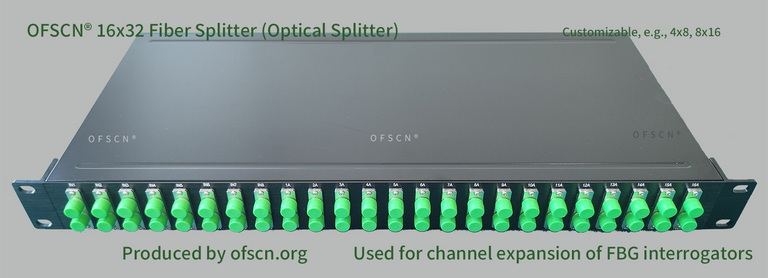
Key Parameters and Application Scenarios:
- Specifications: Commonly includes 16x32 splitters, 8x16 splitters, 4x8 splitters, and 32x64 splitters.
- Engineering Applications: In large-scale multi-point monitoring projects, this series of optical splitters is mainly used in conjunction with the OFSCN® Fiber Bragg Grating Interrogator. By expanding one physical channel of the interrogator into two or three logical sub-channels, under strict wavelength planning, the number of measurement points can be effectively doubled, reducing the average hardware cost per channel.
- Importance of Polarization Performance: Since the wavelength signal reflected by Fiber Bragg Grating sensors is eventually received and calculated by the interrogator. If the splitter’s PDL performance is poor, in actual engineering sites, when the fiber optic cable undergoes random changes in light polarization state (SOP) due to external environmental vibrations, wind, or bending, the signal power reflected back to the interrogator will fluctuate irregularly. This affects the signal-to-noise ratio at the system’s receiving end. Beijing Dacheng Yongsheng Technology Co., Ltd., during the production of this series of splitters, achieves excellent PDL indicators through rigorous encapsulation structures and precise stress control, thereby minimizing the potential negative impact of polarization state changes on the system’s wavelength demodulation and positioning accuracy.