Iven | www.ofscn.net
Last Updated: 09 September 2023
This article introduces the temperature compensation methods and principles for fiber Bragg grating (FBG) strain sensors, addressing the question of whether FBG strain measurements are sensitive to temperature. It also highlights the accurate temperature sensing capability of OFSCN® Capillary Seamless Steel Tube Fiber Bragg Grating Temperature Sensors, which can be used for temperature compensation in FBG strain sensors as well as other types of FBG sensors. Additionally, it presents the temperature compensation scheme offered by DCYS.
This is a companion discussion topic for the original entry at https://www.ofscn.net/fbg-baike/98-temperature-compensation-01.html
It is a pleasure to see the technical overview of temperature compensation for FBG strain sensors posted by @blueman. As an engineer at OFSCN, I would like to provide some additional technical context regarding the practical implementation of these principles using our hardware.
In fiber Bragg grating (FBG) sensing, the central wavelength shift is sensitive to both strain and temperature. To isolate the strain signal, accurate temperature compensation is essential.
Technical Implementation with OFSCN® Products
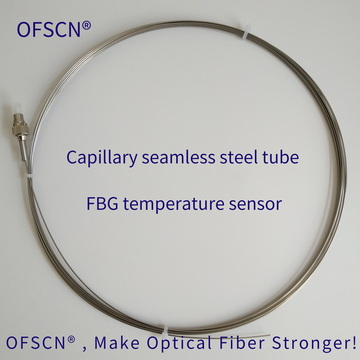
For industrial and high-temperature environments, we typically recommend the OFSCN® 300°C Fiber Bragg Grating Temperature Sensor as the reference compensator. Its seamless steel tube packaging ensures that the FBG inside remains in a “strain-free” state, allowing it to reflect only the thermal environment.
Product Images:
Core Advantages for Compensation:
- High Sensitivity: The 0.9mm (or custom 0.5mm) diameter ensures rapid thermal response, which is critical for real-time compensation in fluctuating environments.
- Wide Range: It supports accurate measurements from -200°C up to +300°C.
- Physical Protection: The all-metal structure protects the fiber from the mechanical stresses that the primary strain sensor is measuring.
Matching Sensors
When performing compensation, it is best practice to match the temperature sensor with the corresponding strain sensor, such as the OFSCN® Alloy Tube Packaged Fiber Bragg Grating strain sensor. Using sensors with similar packaging materials helps in aligning the thermal expansion coefficients during the calculation of the final compensated strain.
For more detailed technical specifications, you can refer to the product page:
OFSCN® 300°C Fiber Bragg Grating Temperature Sensor
If there are specific engineering conditions or complex thermal gradients involved in your project, feel free to share the details for a more focused technical discussion.