What is the smallest change in temperature or strain that the demodulation system can distinguish?
The smallest change in temperature or strain that an FBG demodulation system can distinguish is determined by two primary factors:
- The wavelength resolution of the FBG interrogator (demodulator): This refers to the smallest change in Bragg wavelength that the interrogator can reliably detect, typically measured in picometers (pm).
- The sensitivity of the FBG sensor: This is the inherent characteristic of the sensor, defining how much its Bragg wavelength shifts for a given change in temperature (e.g., pm/°C) or strain (e.g., pm/µε).
The overall system resolution for temperature or strain is calculated by dividing the interrogator’s wavelength resolution by the sensor’s corresponding sensitivity coefficient.
DCYS provides a range of FBG Temperature Sensors and FBG Strain Sensors. Our FBG temperature sensors are calibrated with a temperature-wavelength coefficient (sensitivity) typically expressed in °C/pm, while our FBG strain sensors use a strain-wavelength coefficient (sensitivity) in µε/pm. The effective resolution of the measurement system will depend on the specific FBG interrogator model chosen and the type of FBG sensor deployed.
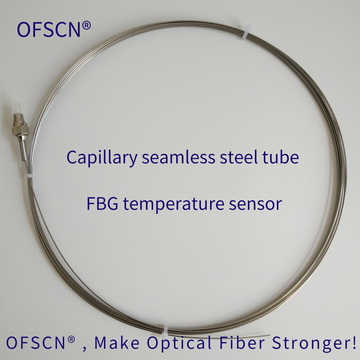
Here is an example image of an FBG temperature sensor:
For more detailed technical parameters, you can visit our product pages:
OFSCN® FBG Temperature Sensors
OFSCN® FBG Strain Sensors
1 Like