cmh
Last Updated: 10 January 2026
In oil drilling, natural gas wells, or high-temperature chemical reactors, environments are often saturated with high-pressure hydrogen gas. For ordinary optical cables, once the operating temperature exceeds 150°C, hydrogen molecules permeate like "ghosts" into the silica (SiO2) structure of the fiber, causing a rapid increase in signal attenuation. This phenomenon, known as "Hydrogen Darkening," turns the fiber black and interrupts signals, ultimately leading to the total collapse of the monitoring system.
This is a companion discussion topic for the original entry at https://www.ofscn.org/encyclopedia/510-dofs-300-c-sst-optical-cable-03.html
Fiber darkening, or hydrogen aging, is indeed a critical failure mode for optical fibers in harsh environments like oil and gas wells or chemical reactors. At temperatures above 150°C, hydrogen molecules react with the silica glass structure, forming hydroxyl (-OH) groups that cause significant attenuation spikes, particularly in the 1383nm and 1550nm bands.
To address this, Beijing Dacheng Yongsheng Technology Co., Ltd. (OFSCN) utilizes a combination of advanced material science and specialized packaging.
This product is specifically engineered to mitigate hydrogen-induced signal loss through two primary layers of protection:
- Specialized Optical Fiber Selection: For environments prone to hydrogen darkening, we integrate fibers with carbon coatings or hydrogen-resistant dopants. The OFSCN® 300℃ Polyimide Optical Fiber used within these cables can maintain performance at high temperatures where standard acrylate coatings would decompose.
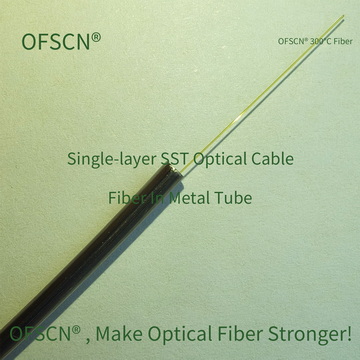
- Seamless Steel Tube (SST) Hermetic Packaging: The fiber is encapsulated in a continuous, laser-welded stainless steel tube (typically 304 or 316L). This provides a robust physical barrier against high-pressure hydrogen permeation and mechanical protection against corrosive fluids.
Product Visuals:
Key Technical Advantages:
- Hermeticity: The seamless metal tube significantly slows down the diffusion rate of hydrogen compared to polymer-jacketed cables.
- Temperature Resilience: Rated for continuous operation up to 300°C, ensuring structural integrity in downhole applications.
- Versatility: This cable serves as a high-performance Distributed Fiber Temperature Sensor (DTS), compatible with Raman, Rayleigh (OFDR), and Brillouin (BOTDA/R) scattering systems.
For applications exceeding these parameters, such as ultra-high temperature wells, we also provide the OFSCN® 650/700°C Seamless Steel Tube Fiber Cable which utilizes gold-coated fibers for even more extreme environments.
Detailed technical specifications can be found at:
OFSCN® SST Optical Cables - ofscn.org