In high-temperature, high-pressure hydrogen environments, how do seamless tubes delay the ingress of hydrogen molecules into the fiber?
In high-temperature, high-pressure hydrogen environments, seamless metal tubes significantly delay the ingress of hydrogen molecules into the optical fiber primarily through two mechanisms:
- Physical Barrier and Reduced Permeability: The seamless metallic material (such as stainless steel or alloys) forms a robust, dense physical barrier around the optical fiber. Compared to polymer coatings, metals exhibit a much lower hydrogen permeability. Hydrogen atoms and molecules must diffuse through the solid metal lattice, which is a significantly slower process than permeation through typical polymer coatings. This inherent material property of metals greatly impedes the rate at which hydrogen can reach the fiber core.
- Absence of Micro-channels and Defects: The “seamless” nature of the tube is crucial. Unlike welded tubes or those with potential manufacturing defects, a seamless tube presents a continuous, uniform barrier without any preferential pathways or micro-channels that hydrogen molecules could exploit for faster diffusion. This ensures that the only way for hydrogen to reach the fiber is through the slow diffusion process directly across the dense metallic wall.
This all-metal seamless packaging design helps to mitigate the hydrogen darkening effect, which can lead to increased attenuation and performance degradation of optical fibers in hydrogen-rich environments.
OFSCN® offers various OFSCN® Seamless Steel Tube Fiber Cables designed to operate in such harsh conditions, providing enhanced protection against hydrogen ingress and high temperatures.
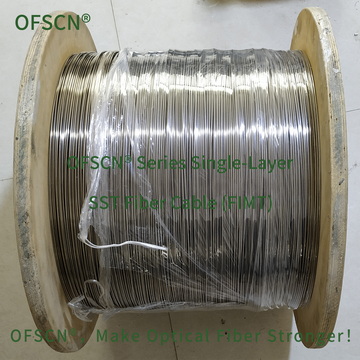
Here is a standard picture of our seamless steel tube fiber cable:
You can find more details on our seamless steel tube fiber cable products here: