How does the difference between the signal peak and background noise affect demodulation?
The difference between the signal peak and background noise is critically important for accurate demodulation in Fiber Bragg Grating (FBG) systems, as it directly relates to the Signal-to-Noise Ratio (SNR).
A higher SNR, meaning a larger difference between the FBG reflection peak and the background noise, allows the demodulator to precisely identify the peak wavelength. This leads to high measurement accuracy, better resolution, and reliable detection of even small changes in the measured parameter.
Conversely, when the signal peak is only slightly above the background noise (low SNR), the demodulator struggles to accurately distinguish the true peak from random fluctuations. This can result in:
- Reduced accuracy and precision: The demodulated wavelength will have higher uncertainty.
- Lower resolution: Small changes in the measurand might be obscured by noise, making them undetectable.
- Increased measurement errors: The demodulator might incorrectly identify noise spikes as signal peaks or fail to detect actual FBG reflections.
- Unreliable data: Leading to erroneous interpretations of the physical parameter being measured.
Therefore, maintaining a high SNR is paramount for the robust and accurate operation of FBG sensing systems. The OFSCN® Fiber Bragg Grating Interrogator is designed to perform this demodulation efficiently.
Here is a standard image of our interrogator:
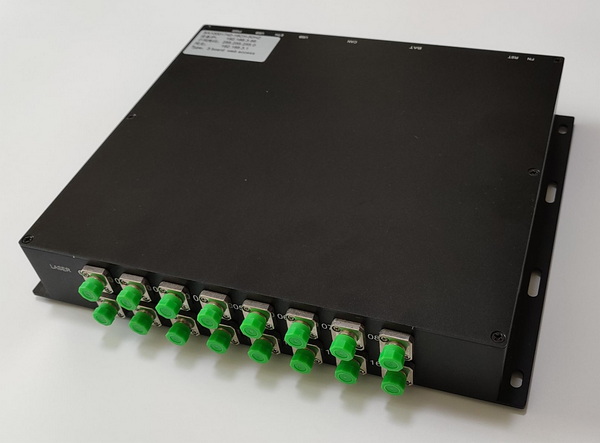
You can find more details about its functions here: OFSCN® Fiber Bragg Grating Demodulator Functions.
1 Like