Splitting Precision is the System Core: In-Depth Interpretation of OFSCN® Fiber Splitter Performance Metrics - DCYS - ofscn.org

cmh Last Updated: 09 November 2025

Fiber Splitters play the role of the "heart" in Passive Optical Networks (PON) and multi-channel fiber sensing systems. Any loss of optical power or uneven distribution directly impacts the performance and budget of the entire link.


This is a companion discussion topic for the original entry at https://www.ofscn.org/encyclopedia/491-fiber-splitter-01.html

Optical power distribution is indeed a critical factor in high-precision sensing networks. In multi-channel Fiber Bragg Grating (FBG) systems, the performance of the splitter determines the signal-to-noise ratio and the overall reliability of the data.

Technical Overview of OFSCN® Fiber Splitters

Optical splitters are essential for expanding the capacity of an FBG interrogator. By using a splitter, a single physical channel on the interrogator can be logically extended to support multiple fiber strings, provided that the wavelength windows are strictly managed to avoid overlap.

Key Technical Parameters of OFSCN® Optical Fiber Splitter:

  • Common Configurations: 1x32, 8x16, 4x8, 32x64, and other custom ratios.
  • Application: Primarily used to increase the channel density of an OFSCN® Fiber Bragg Grating Interrogator, thereby reducing the cost per channel in large-scale monitoring projects.
  • Precision Requirement: High splitting uniformity and low insertion loss are required to maintain signal integrity across all sub-channels.

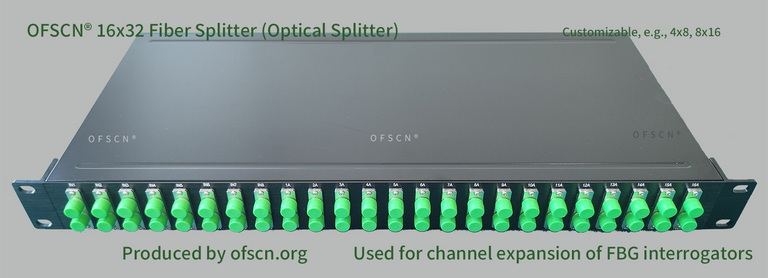
Standard Product Image

Below is the visual representation of a high-density OFSCN® splitter module:

For detailed performance metrics including insertion loss (IL) and polarization dependent loss (PDL) for specific split ratios, you can refer to the technical documentation here:
Link to OFSCN® Optical Fiber Splitter