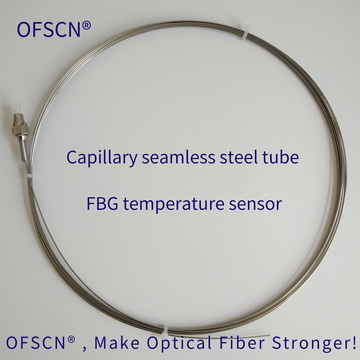
OFSCN® 300°C Capillary Seamless Steel Tube Fiber Bragg Grating Temperature Sensors (FBG Thermometers) produced by DCYS undergo calibration before leaving the factory, and the basic temperature coefficients (also known as calibration coefficients or calibration functions) for the fiber bragg grating sensors are provided along with the product. Here is a brief explanation of the calibration for this product:
This is a companion discussion topic for the original entry at https://www.ofscn.net/fbg-baike/248-temperature-coefficient-300.html
This technical brief provides an overview of the factory calibration process for the OFSCN® 300°C Fiber Bragg Grating Temperature Sensor. As these sensors are designed for high-performance thermal monitoring, precise calibration is essential to translate the reflected wavelength shift into accurate temperature readings.
1. Technical Principle of Calibration
The OFSCN® 300°C Fiber Bragg Grating Temperature Sensor utilizes a specialized capillary seamless steel tube packaging. While many standard FBG sensors use a linear (first-order) calibration at lower temperatures, sensors operating up to 300°C often exhibit slight non-linearity due to the thermal expansion properties of the metal packaging and the thermo-optic coefficient of the fiber at elevated temperatures.
2. Standard Calibration Function
For the 300°C series, DCYS typically provides a polynomial (quadratic) calibration formula. The relationship between the temperature (T) and the Bragg wavelength (\lambda) is expressed as follows:
T = A \cdot \Delta\lambda^2 + B \cdot \Delta\lambda + C
- T: Temperature in Celsius (°C).
- \Delta\lambda: The wavelength shift (pm) relative to the reference wavelength.
- A, B, C: Factory-calibrated coefficients unique to each sensor.
3. Product Features & Advantages
- Encapsulation: Single-layer seamless steel tube (standard OD 0.9mm, customizable to 0.5mm).
- Stability: The all-metal seamless tube design eliminates the creep issues associated with traditional adhesive-based sensors, ensuring long-term reliability at 300°C.
- Multi-point Capability: A single sensor string can be produced with multiple sensing points (typically up to 10 points when used with a 40nm interrogator).
Standard Product Images:
For further technical specifications or to review the complete data sheet, you may visit the official product page:
OFSCN® 300°C Fiber Bragg Grating Temperature Sensor