Iven | www.ofscn.net
Last Updated: 30 December 2023
This article introduces the operating temperature range of the OFSCN® 500°C Capillary Seamless Steel Tube Fiber Bragg Grating Temperature Sensor (FBG Thermometer), including its maximum high-temperature and low-temperature resistance values. It also discusses the determination method and principles of the operating temperature range of fiber Bragg grating temperature sensors, including the stainless steel material and femtosecond fiber bragg grating used.
This is a companion discussion topic for the original entry at https://www.ofscn.net/fbg-baike/114-temperature-range-350.html
This technical summary provides further detail on the operating capabilities and structural composition of the OFSCN® 500°C Fiber Bragg Grating Temperature Sensor mentioned in the post.
Technical Principles and Performance
The temperature range of these sensors is determined by the synergy between the protective encapsulation and the internal optical fiber grating.
- Thermal Stability: While standard UV-written FBGs may experience “decay” or erasure at high temperatures, the use of Femtosecond Fiber Bragg Gratings (as referenced in the Wiki) allows for stable performance at high temperatures.
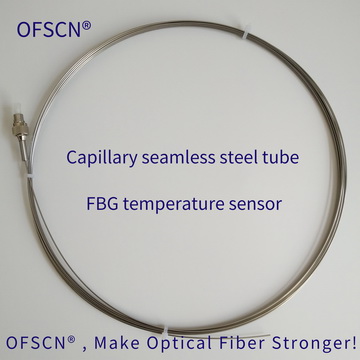
- Encapsulation: The OFSCN® 500°C Fiber Bragg Grating Temperature Sensor utilizes a specialized single-layer seamless steel tube technology. This construction ensures that the sensor can withstand extreme environments ranging from -200°C to +500°C without the degradation common in adhesive-based sensors.
- Physical Dimensions: The standard outer diameter is 0.9 mm, though it can be customized down to 0.5 mm for applications requiring minimal thermal mass or high spatial integration.
Product Visuals
Below are the standard physical representations of the seamless steel tube packaged sensors:
Key Specifications
- Default Connector: FC/APC (Customizable to ST, LC, SC).
- Standard Length: 2 meters (Customizable from 30 cm to several dozen meters).
- Calibration: Provided from room temperature up to 500°C using a quadratic polynomial formula (℃/pm).
- Multiplexing: While single-point sensors are standard, multi-point strings can be produced (typically up to 5 points per string when used with a 40nm interrogator).
For detailed technical datasheets, you may visit the official product page:
OFSCN® 500°C Fiber Bragg Grating Temperature Sensor