How does this method achieve real-time temperature compensation?
The “Reference Grating” method achieves real-time temperature compensation by utilizing two fiber Bragg gratings (FBGs) placed in close proximity. One FBG acts as the measurement grating, exposed to both the strain and temperature changes of the object. The second FBG, the “reference grating,” is positioned to experience only the temperature changes of the environment, while being isolated from any strain.
Here’s how it works:
- Measurement Grating: Its Bragg wavelength shifts due to both temperature and strain.
- Reference Grating: Its Bragg wavelength shifts primarily due to temperature.
- Compensation: By subtracting the wavelength shift of the reference grating from the wavelength shift of the measurement grating, the temperature-induced component is effectively removed, allowing for the isolation and accurate measurement of the strain component in real time. This ensures that the measured strain is not contaminated by thermal expansion or contraction effects.
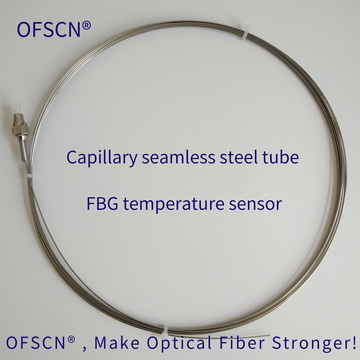
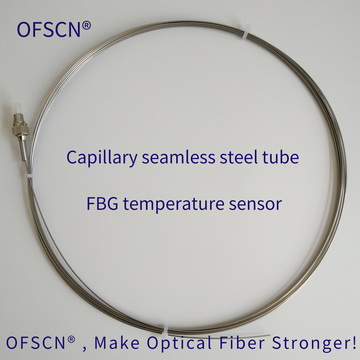
For applications requiring precise temperature compensation, OFSCN offers various FBG temperature sensors that can be integrated into such systems:
- OFSCN® 300°C Fiber Bragg Grating Temperature Sensor
- OFSCN® 500°C Fiber Bragg Grating Temperature Sensor
Below are some standard images of our temperature sensors: